
When was the last time you checked an email from a company and felt excited about getting another newsletter? You probably did not feel that way. Most marketing emails stay closed in the promotions folder while companies try to figure out why people are not engaging.
When your phone rings, with that familiar blue tick you probably check it right away. Everyone does. That quick attention is the money of today’s business. This particular habit is why WhatsApp Marketing is the marketing method around right now.
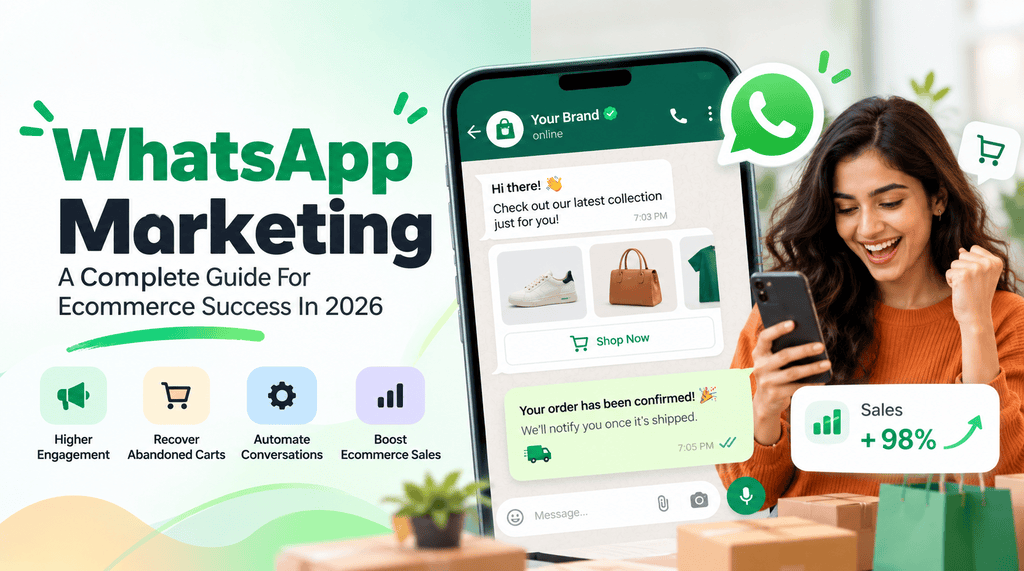
In this guide we are going to talk about how to turn people who chat casually into customers who stay loyal using the WhatsApp app. We will also cover how to stop shopping carts from being left and how to use marketing tools properly. It is a way to increase customer engagement and bring in real money.
What is WhatsApp marketing?
WhatsApp marketing refers to using the messaging platform to engage consumers directly. Using this channel enables brands to execute a direct to-consumer (D2C) strategy. Compared to traditional marketing channels WhatsApp marketing allows companies to have a two-way communication channel with consumers.
For instance WhatsApp Business API comes with tools such as Business Solution Providers (Kwik Engage)notification tools for managing orders and checkout tools for a headless experience to help brands communicate with consumers directly. Apart from the above feature WhatsApp Marketing could help ecommerce brands execute remarketing campaigns, recover abandoned carts and manage order notifications directly on WhatsApp.
Why should you use WhatsApp marketing?
You might be wondering if you need yet another marketing channel to manage. The short answer is yes as the digital ecosystem has changed considerably. Plenty of reports on WhatsApp marketing metrics only serve to illustrate how vital it is today as a channel providing almost guaranteed reach.
Let’s understand why WhatsApp for ecommerce is essential for your business
High Open Rates: Unlike email marketing campaigns that languish at around 20% open rates, WhatsApp campaigns are achieving 98%+ open rates meaning nearly every message you send reaches your intended target customer.
Speed: It is an instant channel with 80% of messages read within the first 5 minutes of receipt. With billions of active users across the globe, the speed you can drive decision making on the part of your customers is invaluable in a flash sale or time sensitive launch scenario.
Personal Connection: It sits alongside messages from your family members and best friends. The inherent trust that the channel inspires (it feels less like a corporation and more like someone in their contact book) builds stronger relationships with your customer than any other channel available.
WhatsApp Business App vs. WhatsApp Business API
It is a free messaging software for small business owners who want to manage customers personally on their phones.
- Best for: solo entrepreneurs and microbusinesses with a small customer base.
- Limited by: single-device use – if five hundred customers write to you at your flash sale, your personal knowledge and capacity to handle the deluge will degrade by several orders of magnitude.
2. The WhatsApp Business API
WhatsApp Business is a powerful communication platform that integrates with third-party tools allowing to automate the conversation process seamlessly. Although WhatsApp marketing cost is related to the number of conversations, it is worth investing in such a messenger to increase ROI through the process of WhatsApp automation.
Best for: growing D2C brands and Enterprise eCommerce scaling operations searching for advanced WhatsApp marketing software
Advantage: it enables Headless Checkout and automated RTO reduction across multiple agents.
Feature: WhatsApp Business App vs WhatsApp Business API
WhatsApp Business App vs WhatsApp Business API: 7 Critical Differences You Should Know About Essay
1. Cost
WhatsApp business app is free of charge. It is essential to state that Meta might charge organizations using the WhatsApp Business API for Meta’s messaging service. Additionally, depending on the provider, there might also be fees associated.
2. Team Access
WhatsApp business app allows only one main phone and several connected phones. Multiple agents or representatives can share a common WhatsApp Business API software instance depending on the provider.
3. Broadcasts
It is restricted to a certain extent. One is only able to communicate with fewer people using broadcast lists. The WhatsApp business API provides wider reach and audience targeting options as long as it is within Meta’s rules and messaging limits.
4. Automation
WhatsApp business app has limited automation features like greetings and away messages. Quick replies are also available. WhatsApp business API offers chatbot automation and omnichannel engagement which can be integrated into the business app by approved third-party providers. In essence, it permits end-to-end automated customer experience.
5. Checkout Experience
Businesses cannot directly checkout items within WhatsApp when using the WhatsApp business app. In this situation, businesses can send links to products and complete purchases on websites. However, the WhatsApp business API allows businesses, depending on their setup with other approved applications, to offer a checkout experience that allows them to finish purchasing.
6. Official Business Verification
There is no official business verification option as one downloads the WhatsApp business app. In WhatsApp business API, businesses get access to the official Meta Verification which allows them to add a green or blue business badge if they meet criteria set by WhatsApp standards.
7. Third-Party Apps and Tools
The WhatsApp business app offers limited third-party tools’ integration. On the contrary, businesses that use the WhatsApp business API exchange data with their approved business software tools like Shopify or WooCommerce depending on the provider.
How to get started with WhatsApp marketing
Getting started with WhatsApp Business API is not as simple as downloading an application from App Store
Below are the step by step road map that you must follow before going live
Phase 1 : Prerequisites
Before booking for a Demo, there are 3 important things that you need to have at hand. It will help us move your onboarding process faster by weeks
Fresh Phone Number : You cannot use the number that you are using for personal WhatsApp or Business App. You will need a fresh number to migrate into API successfully
Meta Business Manager: You need an active Facebook Business Manager account with Admin access. This is where your WhatsApp account will technically live and where you will administer the billing and permissions.
Website & Legal Docs: Meta needs to make sure that they are onboarding legitimate businesses only. Hence, you will need to have your GST certificate and Company PAN card along with a live website URL for verification purposes.
Phase 2: Partner with a BSP (Business Solution Provider)
You can’t use WhatsApp’s API directly. You’ll need to use a Business Solution Provider (BSP) as an intermediary.
The Step: Sign up with WhatsApp business solution providers, such as Tech earth Engage
The Why: We offer you a user interface (UI) that makes the API more accessible and user-friendly. The interface lets you execute and monitor your campaigns and profits.
Phase 3: The ‘Blue Tick’ verification
You have seen these little blue checkmarks next to reputable brands. They are ultimate trust indicators for your customers.
The Process: With an activated API account, you can apply for the Official Business account status directly in your BSP dashboard to boost your credibility with your customers.
The Requirement: Meta offers this verification exclusively to prominent businesses. A significant amount of press coverage and a verified Facebook presence dramatically improves your chances of passing the verification.
Phase 4: Integration & inventory sync
You need to connect WhatsApp to your inventory to enable order placement and browsing. This is how you turn a basic WhatsApp chat interface into a fully-fledged WhatsApp ecommerce store. This integration also unlocks your ability to run hyper-targeted marketing campaigns by allowing you to segment your audience.
For Shopify and WooCommerce: establish connections of your online store with these platforms with the compatibility of product information such as prices and availability to provide your chatbot with the relevant information and respond to customer questions about this data more efficiently.
Configure automated flows: eliminate the need to configure each flow from scratch using the existing automation templates. Define the automation processes for abandoned cart recovery, recovering the cart, and providing order status information to improve communication with the client and increase conversions.
Phase 5: The ‘Soft Launch’
Avoid sending out a broadcast message to your entire contact list on ‘Day 1’: you want to gauge the effect of the WhatsApp campaign and maintain a healthy sender quality rating.
Start small: send out a message to your internal team or a small group of your VIP customers to test the process and make sure that everything goes smoothly.
Monitor your Quality Rating in the dashboard: if your users can mark your company as spam, you will have a reduced sender quality rating. In order to increase the limit to an unmetered high-quality sender, you need to monitor the rating closely.
Effective WhatsApp marketing strategies
To fully utilize WhatsApp’s capabilities, you have to think beyond the most evident use cases. Here are the WhatsApp marketing strategies that will help you achieve your goals:
1. Getting customer opt-ins
The first rule of WhatsApp Marketing is to not spam people, because if you send unsolicited messages, you will quickly become annoying and blocked. To get customers to sign up for your WhatsApp updates, you can make that process more effortless by utilizing click-to-WhatsApp ads’ (social media ads) to acquire high-quality subscribers instantly.
Pro Tip: Add a Get Updates on WhatsApp checkbox at your checkout, or offer a ten percent discount code that gets delivered only via WhatsApp. Make them want to share their contact details and join.
2. Recovering abandoned carts
A significant number of customers add items to their carts and leave the purchase unfinished. WhatsApp allows the company to contact such customers, notify them about their abandoned items and help make the purchase.
The standard practice to manage such situations is to send clients a text message with a link to the website, where they can re-find the items in their cart and complete the purchase. As a result, it may be complicated by additional registration, verification, or information entry steps.
Instead the company can send a WhatsApp message to a customer with a picture of the product, a brief reminder, and a CTA button “Complete your purchase.” If the application supports the technology and checkout system, the customer will be able to pay for the item with fewer steps and additional convenience.
3. Reducing RTO (Return-to-origin)
Cash-on-Delivery orders face high reversal rates due to customer’s reconsideration and change of mind before the delivery. You can reduce such cases with a high margin by simply automating the verification step after the order confirmation.
The Fix: Use WhatsApp to verify COD orders.
Why it works: It filters out the impulsive accidental orders and ensures that the customer is serious about the purchase, thus saving you shipping costs
4. Convert COD to prepaid
For cash flow management, prepaid orders always remain better than cash on delivery. You can use automation to encourage the customers to change their preferred mode of payment before the order is shipped.
The Strategy: Send an automated message with a small offer right after a COD order is placed, offering them a discount if they change their mode of payment to prepaid.
The Impact: Such a simple trick can save you a lot of RTO cases in cash on delivery and help you maintain a healthy cash flow in your ecommerce business.
5. Customer retention strategy
Acquiring new customers is expensive. To reduce the cost you need to learn how to retain clients. One of the most effective ways for customer retention is personalized WhatsApp marketing. It helps get customers back and drive sales through timely product recommendations or exclusive offers.
The Tactic: create win-back flows for clients who haven’t purchased in sixty days. Send them a personalized catalog of newly added products according to their past purchase.
Best practices for WhatsApp marketing
1. The Golden Rule of Consent (Opt-in compliance)
Unlike the consent you may get with emails, you cannot do cold outreach via WhatsApp as WhatsApp needs active opt-ins
Active Opt-In: The user has actively checked the box that says I agree to receive order updates and offers on WhatsApp for you to comply
Easy Opt-Out: Every message should have an opt-out choice like a Stop button/footer text for users to express their preference.
2. Message Frequency and Timing Best Practices
There has to be a balance between frequent but ineffective reminders from the companies about the promotions that are currently available. Creating a schedule helps achieve the level of reminder frequency at which the company is still able to establish contact with the customers to remind them about the ongoing offers.
The company needs to establish a certain frequency for sending the messages; this schedule should be created for each customer segment separately. It is essential to determine at what time it is better to send marketing-related information so that it is convenient for the customers to see the message and, thus, have an increased chance of converting. One of the most convenient moments for sending the marketing messages is during lunch breaks and in the evenings when the target audience is unlikely to be occupied with other daily tasks. The best time for sending the message also depends on where the target audience is located in the GMT time zone. The frequency of the messages should also be related to the response rate and the amount of blocked or unsubscribed messages.
3. Content strategy: conversational Vs transactional
Your content should be relevant to the medium; since WhatsApp is a casual medium, your content should be informal. Here are some key ideas to help you develop great content:
Brevity: Keep your key message under one hundred and fifty characters to enable faster reading by the end-user.
Rich Media: Avoid text-only messages as much as possible, since they have a lower conversion rate. Instead, use images and videos to create eye-catching, visually rich messages. Catalogue products using PDF files attached to the messages.
Interactive Buttons: Do not ask your customers to reply ‘Yes’ or ‘No’, or provide any other responses via text. Use WhatsApp’s Quick Reply or Call to Action buttons instead.
4. Human-in-the-loop automation
Chatbots play an important role in the context of scale, but they can be frustrating, so you should use unified protocols across all eCommerce communication channels to deliver empathy and speed at the same time. There is a list of crucial rules that should be implemented when working with chatbots to improve the situation and make users comfortable with the technology.
The Escape Hatch: The bots should always give an opportunity to chat with the Agent. Moreover, if a user gets stuck in the loop, your bot should initiate the call with the person to solve the issue.
Context Preservation: When interacting with an Agent, the user should not repeat the same information that was previously provided by him. It should be automatically available for the customer service employees to access the conversation history.
Key metrics to track WhatsApp marketing
You cannot improve what you do not measure. To understand the effectiveness of your WhatsApp Marketing, take a step beyond Vanity Metrics. These are the metrics that matter:
Read Rate: this shows that your brand name has acquired trust from your audience and your message timing is appropriate.
Click-Through Rate (CTR): this demonstrates that the offer and creative content are strong enough to convince the user after reading.
Conversion Rate: shows what percentage of users have decided to buy after clicking on the link in your message. In other words, it measures the ROI of your campaign creative.
Block Rate: it is a critical metric that reflects the campaign’s health. A high Block Rate should trigger an immediate pause of your campaigns and a rethink of your content strategy to avoid account banning.
Abandoned cart recovery rate: shows how much revenue you are able to recover from abandoned carts using WhatsApp Marketing. This directly affects your bottom line.
Orders placed through WhatsApp: this metric measures the revenue directly generated from your WhatsApp Marketing use cases and catalog sales.
Bridge the gap between ‘Just browsing’ and ‘Final sale’ with WhatsApp marketing
If you are ready to leave the chasing game of acquiring customers via email and shift to real conversations that convert, it is time to level up your stack. WhatsApp Marketing is no longer an option but an infrastructure for any modern D2C business success.
By implementing the strategies listed in this guide, you will shift from the passive acquisition mode to the active revenue-generating one and provide your buyers with a natural but highly convenient shopping experience.
See how headless checkout and RTO protection work in real-time.
Frequently Asked Questions About WhatsApp Marketing
1. How could WhatsApp marketing benefit businesses?
WhatsApp marketing helps companies to maintain a connection with customers, provide all types of information about a particular business, answer questions and increase customer engagement.
2. What type of information should companies include when texting their customers?
Companies should send information regarding the company’s news, offers and coupons, updates about the order status, and reminder texts.
3. What are the benefits of using WhatsApp marketing than email marketing?
WhatsApp marketing is a new way of approaching customers through chats. Emails are good for newsletters and any specific information about the business. Using WhatsApp and emails together would be more effective for the business.

One thought on “WhatsApp Marketing: A Complete Guide For Ecommerce Success In 2026”