
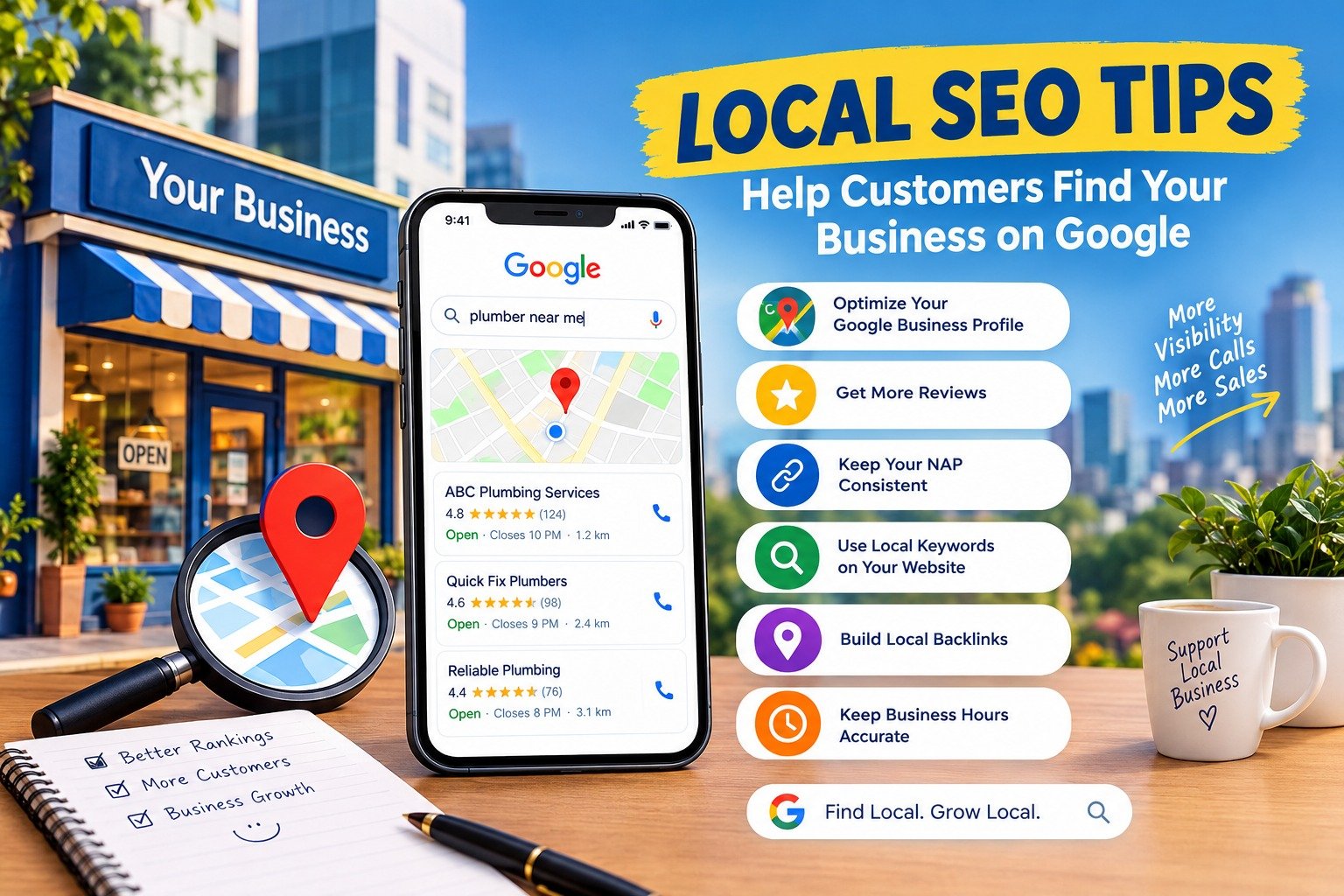
It’s not a big deal. I mean, it usually means you’re losing a call, a booking, or a sale to someone else if a customer says they’d had a hard time finding you on Google.
Demystifying local SEO — insider guide to search optimization for small business owners with no big access to an SEO team or Google to test it over months and months on their own. Anybody from plumbers, dentists, HVAC repair people, salonistas, small retail store owners in this one.
Picture what this is about. People google something like “plumber near me” at 9 PM + there’s a water leak in the bathroom. They are not going to scroll for 20 mins. They will call the first 2-3 businesses that look legit. If you’re not there, you’re out. That’s why this matters. Not because it’s an SEO trend but because people are already looking for you there, beyond your reach.
Why Local SEO Matters for Local Businesses
Local SEO helps you appear when people nearby search for what you sell. Plain as that.
You don’t need a huge budget. You don’t need a special technical SEO team. All you need is a complete Google Business Profile: uniform business details, real reviews, and locally relevant content.
Over the years this came up a number of times, in fact. An AC Repair business in Delhi in May and June were having some low sales. The brand “AC repair open now” — they were seen on Google at 7 PM and Google already said it’s closed. They always stuck with 10 AM on Google profile but the owner by himself says they already open at 8. So the fact saved them from a missed opportunity all month because all that mattered in this case about the hours on Google profile with given local SEO details could win for better local leads. Take a look!
Also, these great results through local SEO. Details. Real outcomes.
1. Optimize Your Google Business Profile
People have a first look at your Google Business Profile, but not through your website or your Instagram — their profile.
Your information, including name, address, timing, photos, reviews, services is listed. Your Google storefront? If your establishment appears a little unfinished, customers will feel the same.
What to Do
- Start with a main category but avoid generic terms like “Attorney.” Choosing something like “Personal Injury Attorney” has more meaning. The more precise your category, the more Google comprehends what you do.
- Cover every field. Details: Description, services, hours, phone, website, service areas. You’re not going to leave places blank because you’re lazy. I’m just kidding — just not.
- Upload real photos of your store, your team, your work. Whatever the reason why no one likes stock photos, they are real and they can be detected immediately.
- Post on Google weekly. A new service, offer, or update. It only ticks over about five minutes but signals your profile is active.
- Make sure your hours are right. Wrong hours don’t only make customers annoyed — they can work against your visibility in “open now” searches.
2. Make Sure Your Business Yields More Reviews and Get Back to All Reviews
You’re well aware of reviews — they’re one of the leading local SEO signals. They influence your rankings. They influence trust. They influence somebody’s calls or continue scrolling.
It’s not just stars. Google takes into account, among other things, how many reviews you have, how old they are, what people are saying, and whether you respond.
Volume and consistency is what matters. The business of a lot of recent reviews and a 4.3 rating wins against the business of 5 reviews and a perfect 5.0 business.
What to Do
- Tell the same-day yet contented customers. Text a Google review link right away. Time-sensitive — people soon forget.
- Use a QR code on your counter. “Was our service satisfactory? Leave us a review.”
- Respond to Every Review. Thanks to all the positive ones. Stay level-headed. Never argue. A professional response to a bad review can be more damage control to future customers than the one negative review is to you.
- Be specific. I prefer “Emergency plumbing in Andheri was quick” to “good service.” They are tailored to local keywords.
3. Uniquely Confirm Your NAP
NAP means Name, Address, Phone Number — can be the same on your website, Google Business Profile, Facebook, Yelp, Apple Maps, Bing Places, local listings.
Main Street vs Main St sounds like such an absurd detail. Yet, Google follows the rules. Misguided systems never rank you correctly.
What to Do
- Decide on one standard format for your business name, address, and phone number.
- Always use the same NAP element everywhere.
- Delete old or duplicate listings. A previous listing with the wrong phone number means steering your customers to their competitor. Literally.
4. Include Local Keywords on Your Website
Your website tells Google what you do and where you do it. Add local keywords naturally in title, headings, content and meta descriptions. But please — don’t do keyword stuffing robotically.
What to Do
- Use local keywords for a page title. Example: “Emergency Plumber in Andheri | 24/7 Service.”
- Last but not least, double check. Test questions and answers that are set up for other people (make sure it’s not all broken down and not all correct, just that it’s there). You’ve got to be consistent in writing answers properly. Include real customer questions in the section. Keep the answers definitive, direct, and short.
5. Examine Your Local Competitors
You don’t need to direct your attention to the top three local businesses or spy on them.
Put a glance at the Google Business Profiles. Review count. Post rate. Categories. Photos. Even read their bad reviews that serve you with market research at zero cost.
What You Need to Do
- Explore their profiles as compared to yours. Identify gaps. Hitting 20 reviews but seeing them bustling with 200? It shows you have room for improvement.
- Look at their personally negative reviews. Customers have written down exactly what they hate here. Don’t copy them. Do something really nice with one or two ideas.
6. Get Ready for AI-Driven Local Search
AI search is changing how people find local businesses. AI Overviews for many local queries.
Local SEO is not dead — if anything, the fundamentals matter more. AI tools rely on the same sources: your Google Business Profile, your website, reviews, directories, and if your details are sloppy, AI will replicate the mess.
Plan
- Keep on top of your Google Business Profile.
- Follow consistent NAP information through your listings.
- Get a flow of good reviews now and then.
- Share relevant local content on your website. Make sure that it is mobile-friendly and easy to use.
7. Google’s Local Ranking Factors to Prioritize
Google’s local algorithm looks for three things: relevance, proximity, and prominence.
Quick Local SEO Checklist
- ✅ Claim and optimize your Google Business Profile
- ✅ Get Google Reviews and respond
- ✅ NAP appears the same across all platforms
- ✅ Add keywords for your services on your website
- ✅ Create location-relevant blog content and build local backlinks
- ✅ Keep business hours correct
- ✅ Monitor and answer Q&A on Google Business Profile
- ✅ Analyze top local competitors
- ✅ Plan for AI-powered local search
Final Thought
It is not complicated to handle your local SEO. It can get a little tedious though. Many business owners just get annoyed with tackling this task.
Don’t try to do it all at once. Start with the basics. Claim your Google Business Profile. Get five happy reviews from customers this week. Adjust your NAP details. Add local keywords to your primary services page.
That is all. Five reviews. One profile, fixed. One updated page. The biggest company does not always rank first in Google. Google often rewards businesses that can complete small tasks consistently. So apply the local SEO tips learned, stay on top of them, and make sure local folks find you.
Frequently Asked Questions About Local SEO Tips
What is local SEO?
Local SEO makes it easier for people in your area to find your business through Google Search, Google Maps, and searches such as “near me.” It helps nearby customers discover and contact you.
How soon can local SEO make a difference?
The timing varies depending on your competition and how regularly you work on your local presence. Updates to your Google Business Profile may show results in a few weeks, while ranking in a competitive area can take several months.
Does Google Business Profile matter for local SEO?
Yes. It’s a key part of local visibility. Keeping your profile complete, accurate, and up to date can help your business appear in Google’s local map results.
Can customer reviews affect local SEO?
Yes. Reviews can shape both your local visibility and customers’ confidence in your business. Their number, quality, and freshness matter, as does how you respond to them.

One thought on “Local SEO Tips — Let Customers Find Your Business on Google”