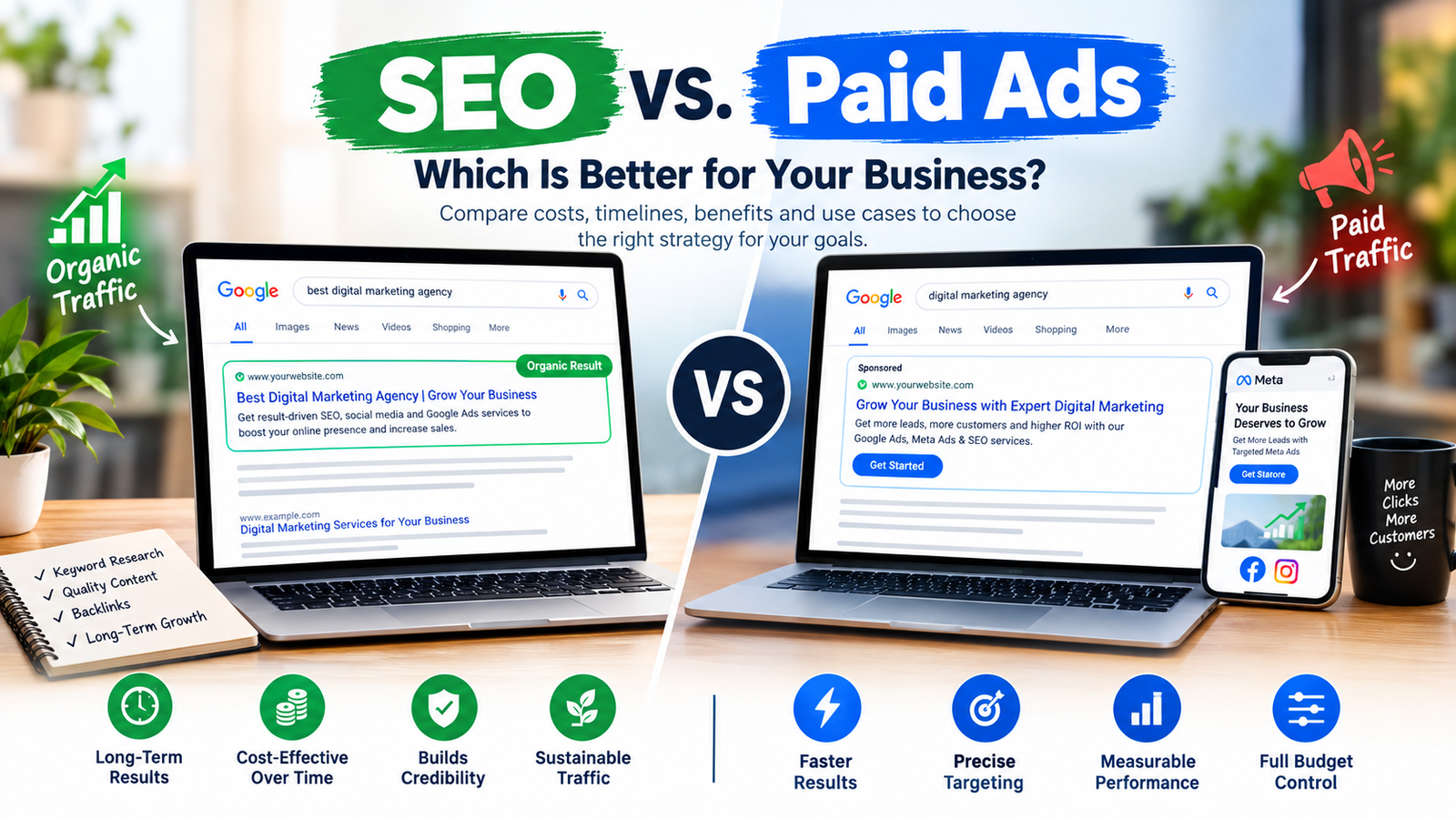
In today’s competitive digital landscape, businesses need a strong online presence to attract potential customers, generate leads, and increase sales. Two of the most popular digital marketing strategies are Search Engine Optimization (SEO) and paid advertising. But when comparing SEO vs paid ads, which strategy is better for your business?
The answer depends on your marketing goals, budget, competition, and the time you can invest in achieving results. SEO helps businesses build long-term organic visibility, while paid advertising can generate targeted traffic as soon as campaigns become active.
In this guide, we will compare SEO and paid advertising, explain their costs and timelines, and help you decide whether to invest in one strategy or combine both.
What Is SEO?
Search Engine Optimization (SEO) is the process of improving a website’s visibility in organic search engine results. It involves optimizing website content, improving technical performance, building relevant backlinks, and creating a better user experience.
The primary goal of SEO is to help your website rank for relevant search queries so potential customers can discover your business without paying for every click.
Key Benefits of SEO
- Long-term organic traffic: Well-optimized pages can continue attracting visitors over time.
- Cost-effective growth: You do not pay Google for every organic click, although SEO requires time, expertise, and resources.
- Increased credibility: Many users value relevant, helpful organic search results.
- Better user experience: Technical SEO and content improvements can make your website easier to navigate.
- Sustainable visibility: Strong rankings can support consistent lead generation when maintained.
Common SEO Activities
SEO typically includes keyword research, on-page optimization, technical SEO, content marketing, local SEO, and link building.
For example, a company selling plants in bulk could optimize its website for keywords such as “wholesale plant supplier in India” to attract relevant business customers through organic search.
What Are Paid Ads?
Paid advertising is a digital marketing strategy in which businesses pay to display advertisements to selected audiences. Platforms such as Google Ads and Meta Ads allow businesses to reach potential customers based on search intent, interests, demographics, and other targeting options.
Google Ads can place your business in sponsored search results, while Meta Ads can promote your products and services across Facebook and Instagram.
Key Benefits of Paid Advertising
- Faster visibility: Campaigns can begin generating impressions and clicks soon after launch and approval.
- Precise targeting: Reach audiences based on relevant targeting criteria.
- Budget control: Set campaign budgets and adjust spending according to performance.
- Measurable results: Track clicks, conversions, cost per lead, and return on ad spend.
- Campaign flexibility: Test different offers, audiences, landing pages, and advertisements.
However, paid advertising requires ongoing investment. Traffic from paid campaigns generally decreases when advertising stops, unless other channels continue bringing visitors to your website.
SEO vs Paid Ads: Key Differences
Understanding the differences between SEO and paid advertising can help you choose the right digital marketing strategy.
| Factor | SEO | Paid Ads |
|---|---|---|
| Traffic type | Organic traffic | Paid traffic |
| Initial cost | Investment in optimization and content | Advertising budget plus management costs |
| Time to results | Usually several months | Can begin within hours or days after approval |
| Traffic duration | Can continue after rankings are earned | Usually depends on ongoing ad spend |
| Cost per click | No direct payment to Google for organic clicks | Often charged per click or through another bidding model |
| Trust and credibility | Can build credibility through useful content and visibility | Sponsored placements are clearly identified |
| Targeting | Based on keywords, content, location, and search intent | Uses keywords, audiences, locations, and campaign settings |
| Best for | Long-term visibility and sustainable growth | Immediate reach, testing offers, and lead generation |
| Main challenge | Takes time and requires ongoing optimization | Costs can rise, and performance depends on campaign efficiency |
Neither strategy is automatically better. The right choice depends on your business objectives and resources.
SEO vs Paid Ads: Which Is More Cost-Effective?
Cost is one of the most important considerations when comparing SEO vs paid ads.
SEO Costs
SEO expenses may include content creation, technical improvements, keyword research tools, link acquisition, and professional SEO services.
Although SEO does not charge you for every organic click, it is not free. You invest in building and maintaining your website’s search visibility.
Over time, successful SEO may reduce your dependence on paid traffic and improve the overall cost-effectiveness of customer acquisition.
Paid Advertising Costs
Paid advertising requires a budget for clicks, impressions, or other campaign objectives, depending on the platform. You may also need to pay for campaign management, creative development, and landing-page optimization.
Your actual cost depends on industry competition, audience targeting, conversion rates, and the value of the products or services you sell.
For example, if you spend ₹10,000 on a campaign and generate 20 qualified leads, your cost per lead is ₹500. However, the campaign’s success also depends on how many of those leads become paying customers and how much revenue they generate.
Which Offers Better Long-Term Value?
SEO can offer strong long-term value when your website consistently attracts relevant visitors and converts them into customers. Paid advertising can provide faster feedback and scalable customer acquisition when the economics are profitable.
To compare them fairly, measure the total cost of acquisition, lead quality, conversion rates, and revenue—not just traffic volume.
How Long Does SEO Take Compared to Paid Ads?
The timeline is another major difference between SEO and paid advertising.
SEO Timeline
SEO is a long-term process. Some improvements may produce early results, but meaningful organic growth often takes several months. Competitive keywords may require considerably more time.
Your timeline depends on factors such as website history, competition, content quality, technical health, and the authority of your website.
Paid Ads Timeline
Paid advertising can begin generating traffic shortly after campaigns are approved and activated. However, getting profitable results may take longer because campaigns need testing, conversion tracking, and optimization.
Important: Fast traffic does not automatically mean fast sales. Both strategies need relevant offers, effective landing pages, and a clear conversion process.
When Should Your Business Choose SEO?
SEO is a strong option if your business wants to build long-term search visibility and attract people actively looking for its products or services.
Consider prioritizing SEO if:
- You want to build a sustainable source of organic traffic.
- Your customers regularly search Google for your services.
- You can invest consistently in content and website improvements.
- You want to establish topical authority in your industry.
- Your business relies on local or informational searches.
- You want to reduce dependence on paid advertising over time.
For example, a coaching institute can create useful pages targeting searches such as “best coaching institute for NEET” and publish educational content to attract relevant students and parents.
When Should Your Business Choose Paid Ads?
Paid advertising may be a better starting point when speed, rapid testing, or immediate market visibility is a priority.
Consider paid ads if:
- You need to promote a time-sensitive offer.
- You are launching a new product or service.
- You want to test customer demand before investing heavily in SEO.
- You need to reach a specific audience or geographic market.
- You have a clear conversion goal and sufficient advertising budget.
- You want to test different landing pages, messages, and offers.
For example, a real estate developer can use Google Ads to reach people searching for properties in a specific location and Meta Ads to introduce a new residential project to relevant audiences.
Remember that paid campaigns should be monitored carefully. Poor targeting, weak landing pages, or ineffective follow-up can waste advertising spend.
Google Ads vs SEO: Which Is Better?
Google Ads and SEO both help businesses reach potential customers through Google, but they work differently.
Google Ads can provide sponsored visibility for selected searches, subject to budget, competition, targeting, and ad approval. It is useful when you want to test offers, reach high-intent prospects, or generate leads more quickly.
SEO helps your website earn organic visibility through relevant content, technical quality, and other ranking factors. It is useful for building long-term search traffic and answering customers’ questions throughout their buying journey.
For example, a business targeting “digital marketing agency in Delhi” could run Google Ads to test demand and generate early enquiries while optimizing its website to rank organically for the same keyword.
This approach allows the business to pursue short-term opportunities while building long-term visibility.
Organic Traffic vs Paid Traffic: What Should You Know?
Organic traffic and paid traffic serve different purposes in a digital marketing strategy.
Organic traffic comes from unpaid search results, while paid traffic comes from advertisements. Both can bring valuable visitors, but the quality of that traffic depends on whether your website meets the visitor’s needs.
Organic traffic may be particularly useful for educational content, service pages, local searches, and customers researching a purchase.
Paid traffic may be especially useful for promotions, product launches, high-intent search campaigns, and retargeting eligible audiences.
Rather than focusing only on the number of visitors, evaluate engagement, qualified enquiries, conversion rates, and customer acquisition costs.
Why Combining SEO and Paid Ads Can Be More Effective
For many businesses, the best strategy is not choosing SEO or paid ads exclusively. It is combining both channels based on business priorities.
Here is how an integrated strategy can work:
- Use paid ads to test demand: Identify which keywords, offers, and landing pages generate relevant enquiries.
- Invest in SEO content: Build useful pages around proven customer needs and relevant search queries.
- Improve conversion rates: Use insights from both channels to refine website messaging and calls to action.
- Track performance: Measure organic conversions, paid campaign results, lead quality, and sales.
- Adjust the budget: Allocate resources according to performance, profitability, and long-term goals.
For instance, if a paid search campaign consistently generates qualified leads for a particular service, your business can also create a high-quality organic landing page targeting the relevant search intent.
This approach helps you balance immediate marketing opportunities with sustainable growth.
How to Choose the Right Strategy for Your Business
Before deciding between SEO vs paid ads, answer these five questions:
1. What is your primary goal? If you need to validate an offer or promote a limited-time sale, paid ads may be useful. If you want to build long-term visibility, SEO may be a priority.
2. What is your budget? Consider both direct advertising costs and the resources required for SEO. Avoid spending more than your business can comfortably support.
3. How competitive is your market? Highly competitive organic keywords may take time to rank for, while expensive paid keywords may require careful campaign management.
4. How quickly do you need results? Paid ads can deliver faster visibility, whereas SEO generally requires sustained effort.
5. Can your website convert visitors? A slow website, unclear service offering, or complicated enquiry form can reduce results from both channels.
Once you understand these factors, you can create a marketing plan that reflects your business needs rather than following a one-size-fits-all approach.
Conclusion: SEO vs Paid Ads—Which Is Better for Your Business?
The choice between SEO and paid advertising depends on your business goals, budget, competition, and timeline.
SEO is a strong investment for businesses that want to develop long-term organic visibility, establish credibility, and attract relevant search traffic. Paid ads are useful for gaining faster visibility, testing offers, and reaching targeted audiences when the campaign economics make sense.
For many businesses, combining SEO with paid advertising provides a balanced approach. Paid ads can support immediate marketing objectives while SEO builds a stronger foundation for future growth.
The most effective strategy is the one that brings the right customers to your business at a sustainable cost.
Ready to improve your digital marketing performance? Review your current website, advertising campaigns, and conversion tracking to identify opportunities for growth. A well-planned combination of SEO and paid advertising can help your business make better marketing decisions and build a stronger online presence.
Frequently Asked Questions (FAQs)
SEO can be better for long-term organic visibility, while paid ads are often better for faster visibility and campaign testing. The right option depends on your objectives, budget, and timeline.
Paid ads can start generating impressions and clicks soon after approval and activation. SEO typically takes several months to produce meaningful results, although timelines vary.
SEO does not charge for individual organic clicks, but it requires investment in content, technical improvements, and ongoing optimization. Google Ads involves advertising costs and potentially management fees. Compare the total cost of acquiring a customer to determine which is more economical for your business.