
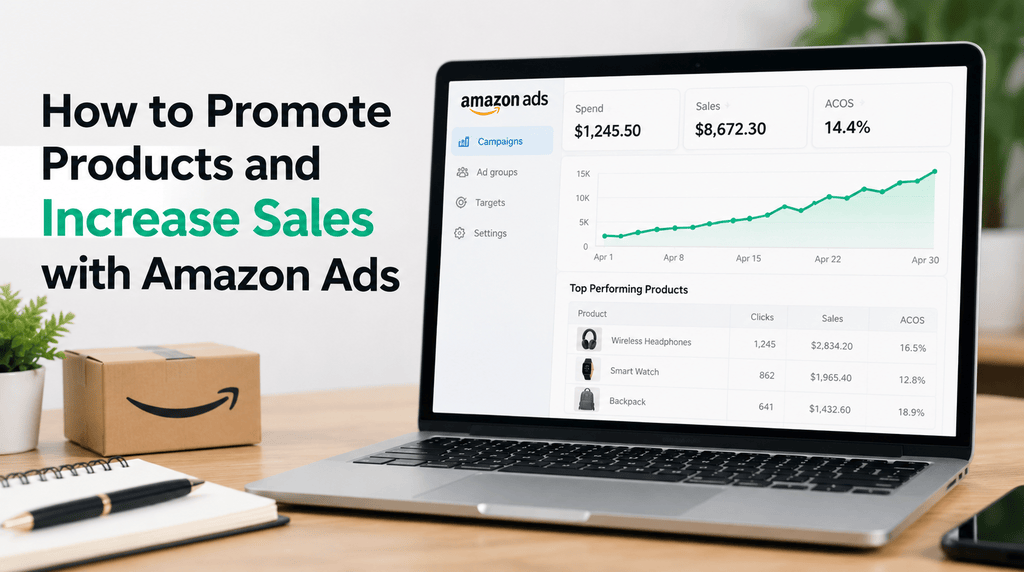
Selling goods on Amazon may be challenging sometimes due to the intense competition. It is not always easy to sell a product despite having the best quality due to the presence of competitors. Therefore, the only way to get an advantage over others is to use Amazon ads.
Amazon.com offers a variety of ad services to help sellers and brands market their goods to targeted customers. By using the right strategy, it becomes possible to drive traffic to a seller’s listing and increase the possibility of conversion.
However, it should be noted that advertising campaigns must be handled properly. In other words, an appropriate advertising strategy should be chosen, and the listing should be optimized in order to get the most out of Amazon ads. The current article aims to explain how Amazon ads work, what advertising services are available, and how sellers can benefit from them.
What Are Amazon Ads?
Amazon Ads is a collection of advertising instruments that allow you to promote your products and brand on Amazon. Your ads can appear in Amazon’s search results and on product pages.
For example, if someone is looking for a backpack, your product may appear among the search results if your ad campaign targets relevant searches and participates in the advertising auction.
Your item will receive another chance to be found by the customer.
In addition to product advertising, Amazon offers multiple ways to promote your goods. Sponsored Products ads, Sponsored Brands ads, and display ads are all different types of Amazon marketing. Which method to choose depends on what products you have and what you want to accomplish.
How Do Amazon Ads Work?
Amazon Ads employs targeting, bidding, and advertising auction mechanisms to define when and where the selected seller’s ad can be displayed. Via this tool, sellers identify the goods they want to promote and define the parameters of their campaigns. Thus, the launch of the Amazon Ads account involves the following steps.
First, sellers must choose products that will be offered for promotion and ensure that product details are correct and informative. In parallel, one should define the targeting criteria based on keywords, products, or automatic targeting options.
Next, establish a bid campaign and specify the amount you are willing to pay for each click and the overall budget. Finally, upon launching the advertising campaign, the seller should monitor the results by analyzing the clicks, expenditure, orders, and sales.
Sponsored Products advertisements are “charged per click,” which means that the advertiser is only billed when a customer clicks on their advertisement. Although this method is comparatively straightforward, one should note that a customer clicking on the ad does not always result in a purchase.
Therefore, one should consider various factors, such as the presentation of the item page, the price of the advertised item, reviews, delivery costs, and similar goods offered by competitors.
Types of Amazon Advertising Campaigns
Which campaign type should you choose? Each campaign type has its strengths to better connect you with the different types of shoppers.
1. Sponsored Products
They promote specific products which means that your product can show up in sponsored product results and product pages. It is often the best place to start if you want to promote a particular product
For instance, you can target search terms related to your item, such as with a kitchen organizer, and attract the right buyers to your product listing. To maximize your results, you should invest in items that have great pictures, good prices, descriptive texts, and are in stock.
2. Sponsored Brands
Sponsored Brands enable qualifying brands to promote their identity and products. Depending on the campaign type and eligibility, ads may include a brand logo, headline, video, and multiple products.
The option may be relevant when promoting several items from the brand. For example, a skincare company advertises multiple cosmetics in one ad. In such a case, customers can browse the brand’s offers and choose the products they need instead of searching for each product individually.
3. Sponsored Display and Display Advertising
Display ads let businesses get their message in front of people who are likely to be interested, on websites and apps that support them. Depending on the specific ad product and where it’s being used, these ads can catch the eye of shoppers who have looked at certain products or have shown interest in similar things.
For instance, someone might look at a product online but not buy it. A well-timed remarketing campaign can then offer another chance to bring that shopper back.
Just so you know, what ads are available, who you can target, and the rules for where ads can show all differ depending on the ad product and the marketplace.
4. Amazon DSP
Amazon Demand-Side Platform (DSP) is a good choice for brands that want to expand their advertising coverage and operate more efficiently within the larger Amazon ecosystem. It covers a wide range of Amazon channels and external inventory. The tool is more involved than a simple Sponsored Products campaign.
The choice between the two options depends on the advertiser’s objectives, budget, audience targeting, and access to the necessary advertising instruments.
How to Promote Products With Amazon Ads
The success of the advertising campaign based on the ads targeting particular products should be planned properly. Firstly, it should be decided which products will bring the most profits.
1. Optimize Your Product Listings First
The product listing itself is crucial to help target the audience and persuade the customer into buying the product. A product listing with poorly targeted ads will most likely not get high conversion rates.
Here are some optimization tips for product listings:
Product title: state clearly what the product is and try to use keywords;
Product images: show the most appealing and informative pictures;
Product bullet points: write down the most attractive and informative facts and specifications;
Product description: describe the product in detail and specify the target audience;
Product price: try to keep the prices a bit lower and check the inventory;
Customer reviews: read the customers’ comments and try to respond to their questions and concerns.
A well-optimized product listing will help the customer determine whether they want to buy the product.
2. Research Relevant Keywords
Keywords help you connect your advertisement with those searching for your product. As such, they should be relevant to the offered item and reflect customer intent.
First, you need to come up with a list of keywords that people may use while searching for the product that you are advertising. You should then look at the suggested phrases and match them to your campaign. For instance, if you sell backpacks, you may consider using the following terms:
- Travel backpack
- Laptop backpack
- Waterproof backpack
- Lightweight backpack
- Backpack for everyday use
Avoid adding every phrase that may be related to your product. Instead, ensure that the terms selected are relevant to the item on sale. Notably, specific keywords enable you to target customers with particular needs. As such, look through the campaign’s search-term reports to identify the searches that you would want to target.
3. Use Automatic and Manual Targeting
Amazon Sponsored Products offers both automatic and manual targeting options.
With automatic targeting, Amazon will attempt to associate your promoted products with relevant shopping searches and products. This option is beneficial in that it may suggest advertising opportunities that a new advertiser might not have thought of.
Meanwhile, the manual option offers more control over what your ads are associated with and allows you to make bid adjustments based on your campaign’s performance.
It is common for advertisers to use both options for different campaigns as while the automatic option may generate useful information for a manual campaign, the manual option offers greater precision. It is important for an advertiser to review the targeting options available to them prior to initiating a campaign as what they select will influence where their ads appear and how they manage their campaign’s performance.
4. Set a Realistic Advertising Budget
Your Amazon Ads budget should be based on your business goals and spending capacity. Having a big budget does not guarantee great results.
First, you need to set the starting bid that your business can afford and begin gathering statistics. Then, you have to analyze the data and adjust your budget according to your findings.
Therefore, when calculating your Amazon Ads budget, you should answer the following questions:
How much can you spend on ads?
What is the percentage of your product’s profit?
How much profit are you making per sale?
What products are the most selling?
How much are you paying per order?
For example, if your product has a low percentage of profit, you should not bid as high as you can for a product with a high percentage of profit.
So, it is essential to calculate your expenses in order to make your Amazon Ads bring more profit than they bring costs.
How to Improve Amazon Ads Campaign Performance
Launching a campaign is not a one-time act; optimizing your current actions allows you to find a balance between what works and what does not, to save the most possible amount of money.
1.Review Search Terms and Remove Irrelevant Traffic
Take a look at the search terms that are triggering your ads and bring you traffic. If there are terms that have a good number of clicks but do not seem to be relevant or bring you any sales, research if these terms could fit any of your products.
You may want to add a negative keyword or a negative product to eliminate traffic from certain terms or products. However, be careful about taking away too much traffic by removing something that has only been clicked a couple of times. Some products require more traffic before an adequate amount of clicks can be achieved.
2.Adjust Bids Based on Results
Not every keyword or product target is equally valuable. Some targets will bring you sales with a good efficiency, others will just waste your budget.
Look at the statistics of your targets and adjust the bids depending on the conversion rates, profitability, and your campaign’s goals.
Moreover, remember to make changes not too often and not at once. Let your changes speak for themselves and bring you the necessary results.
3.Monitor Inventory and Product Availability
Advertising products that are out of stock can waste planning effort and interrupt sales opportunities. Before increasing your expenditure on advertising, make sure that you have sufficient stocks and know the time of their replenishment.
In addition, analyze your inventory on a regular basis. If you realize that you are low on supply, you will have to halt your advertising campaign at some point depending on your inventory plan.
4.Test Improvements Gradually
Apply the data gained from a campaign to find a problem or two. Test a different bid, narrow the focus of one set of keywords or work on another listing.
Then see what changes over time.
In this way, you can take advantage of every change you make, and you learn more, too, while avoiding snap decisions based on emotion or hunch.
How to Measure Amazon Advertising Results
You need to look at the right metrics beyond clicks to understand the advertising costs and business outcomes of your campaigns.
Impressions: This metric shows you the number of times your ad was displayed. This metric is useful to track exposure your campaign receives.
Clicks: This metric reflects the number of times an ad was clicked. This is useful to calculate click-through rate (CTR) to understand the percentage of impressions that resulted in clicks.
Cost per click (CPC): Calculate this metric by dividing the ad spend with the number of clicks. This tells you the average cost for each click.
Conversion Rate: This reflects what percentage of clicks or visits resulted in an order based on the reporting method used.
Advertising Cost of Sales (ACOS): Calculate this by dividoting the ad spend with the attributed sales and multiplying by 100.
Return on Ad Spend (ROAS): This is attributed sales divided by the ad spend. A good ROAS is 5 or higher.
If your campaign spent ₹1000 and made ₹4000, your ROAS would be 4, meaning for every ₹1 spent, you made ₹4 attributed sales. Keep in mind that attributed sales are not profit. You have many other expenses including cost of goods sold (COGS), marketplace fees, shipping, returns, and other expenses to consider.
Common Amazon Ads Mistakes to Avoid
Even the most seasoned sellers make errors in managing their advertising campaigns. Thankfully, many Amazon Ads mistakes can be avoided if sellers learn to recognize them in time.
Firstly, advertising well-optimized listings. Attracting clicks with poorly optimized product pages does little to encourage customers to complete a purchase. Always make sure to optimize your product page before investing more money.
Secondly, irrelevant keywords in campaigns. Expansive use of broad keywords may result in targeting the wrong audience. Pay special attention to keywords and their match types and continuously optimize your campaigns.
Moreover, ignoring reports in favor of taking action. It is important to take action, but changing any part of an advertising campaign blindly will bring more harm than benefits. Always look at reports and take notes.
In addition, getting discouraged and making incorrect assumptions. The key to being a successful Amazon Ads seller is to look at the bigger picture. A company’s campaigns may perform well overall but can suffer a loss because of one underperforming product.
Lastly, increasing the daily budget without a well-defined strategy. Increasing the campaigns’ budget only brings more sales if there is a possibility to make a profit. Always learn how the changes you make affect the overall sales.
Should You Hire Amazon Ads Services?
Managing advertising on Amazon takes much time, analysis, and research. If your company offers numerous products and you need to launch several campaigns, such tasks will consume your resources and significantly slow you down.
Amazon ads services help to create and launch campaigns, conduct research, analyze and optimize the performance of your ads, select the most relevant keywords, and much more.
Moreover, seasoned experts could assist you in targeting the most relevant customers, boosting sales, and optimizing the campaigns’ structure. However, the professional team could not guarantee you specific results because it is impossible to predict the customers’ behavior and the market’s demands.
Before you hire Amazon advertising agencies, make sure to ask for their process, report style, specialization, and experience. You should also clarify what metrics the company uses to measure the results of your campaigns and study their quality score. And finally, remember that any promotion requires investment in it, and you should clearly define your expectations from your chosen partner.
A Simple Amazon Ads Checklist
- An Easy Amazon Advertising Checklist.
- Here’s a straightforward Amazon Ads checklist you can follow when launching or auditing a campaign:
- Confirm your product listing.
- Make sure your product is available.
- Select your keywords or products.
- Select a campaign type.
- Set your bids and budget.
- Review your search terms and ad reports.
- Keep tabs on your ACOS, ROAS, conversions, and profit.
- Tweak your campaigns continuously.
By using this checklist, you can improve your Amazon advertising more effectively and you’ll have a reliable system to follow.
Final Thoughts
Amazon Ads helps businesses reach relevant shoppers and drive sales. Relevant keywords , realistic budget and optimized product listing. Track your campaigns, adjust your bids, eliminate irrelevant targets and scale what works.
With a focused approach, Amazon Ads can become a valuable part of your eCommerce growth strategy. Check out our digital marketing services for expert assistance.