
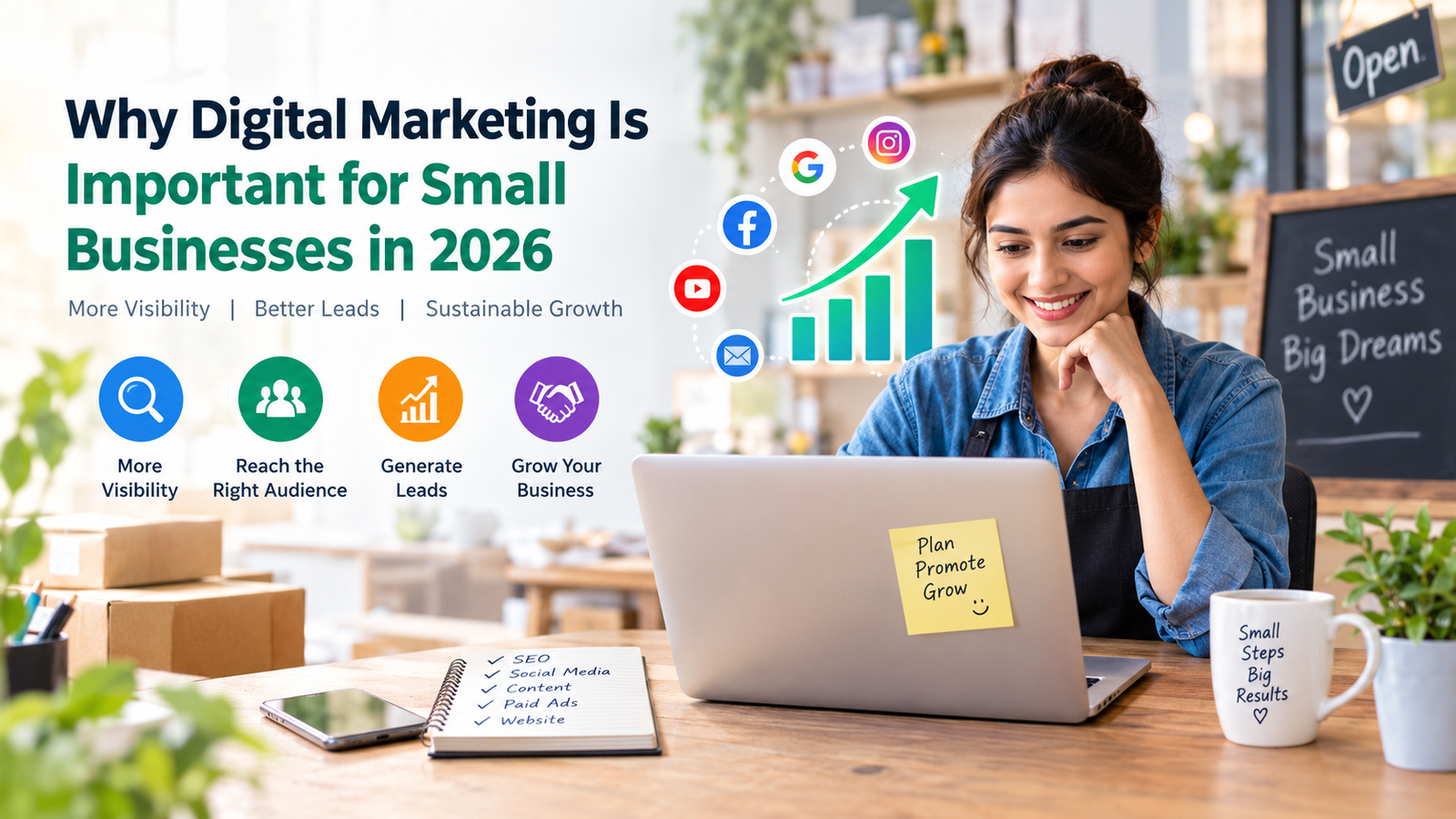
Digital marketing for small business helps companies build an online presence, communicate with their target audience, and create opportunities for business growth. From search engine optimization (SEO) to social media marketing and paid advertising, businesses can choose strategies that match their goals and budgets.
People increasingly use search engines, social media platforms, websites, and online reviews to discover businesses and compare their options. For small businesses, this creates an opportunity to reach potential customers beyond traditional advertising.
Whether you run a local shop, a service-based company, a startup, or an online store, the right online marketing approach can help you connect with customers more effectively.
In this guide, we will explore why digital marketing matters in 2026, its major benefits, and practical strategies small businesses can use to improve their online visibility and attract potential customers.
What Is Digital Marketing for Small Business?
Digital marketing for small business refers to promoting products or services through online channels such as search engines, websites, social media, email, and digital advertising platforms.
Unlike traditional marketing, many digital channels allow businesses to monitor engagement, website visits, enquiries, and conversions. This information helps business owners understand which activities are contributing to their goals.
For example, a local bakery can use Google Business Profile to improve its local visibility, Instagram to showcase products, and a website to display its menu and contact information.
Similarly, a consulting firm can publish educational blog posts, improve its website SEO, and run targeted advertising campaigns to reach potential clients.
The most suitable strategy depends on the business’s audience, industry, objectives, and available resources.
Why Is Digital Marketing Important for Small Businesses in 2026?
Customers often research businesses online before making purchasing decisions. A clear and useful online presence makes it easier for people to discover your business, understand your services, and decide whether to contact you.
Here are the major reasons small businesses should consider investing in digital marketing.
1. Improves Online Visibility
One of the biggest challenges for small businesses is helping potential customers discover their products or services.
Search engine optimization helps businesses improve the relevance and quality of their website content for searches related to their offerings. When people search for relevant products or services, a well-optimized website has a better opportunity to appear in organic search results.
For example, a plumbing company can create useful service pages targeting searches related to plumbing services in its service area.
Local SEO can also help businesses improve their presence in relevant local search results. Maintaining accurate business information, collecting genuine customer reviews, and publishing useful website content can support this effort.
By improving online visibility, digital marketing helps small businesses become easier to discover when potential customers need their services.
2. Helps Reach the Right Audience
Not every person is a potential customer for every business. Reaching people who are genuinely interested in a product or service is therefore important.
Digital marketing for small business allows companies to tailor their messages according to audience needs, location, interests, and search behaviour, depending on the platform and campaign type.
For example, a local fitness studio may focus on people in its surrounding area, while an online store may target customers in several cities.
Search advertising can connect businesses with people actively searching for particular services. Social media campaigns can introduce products to relevant audiences, while email marketing can help maintain relationships with interested customers.
A focused strategy helps businesses use their time and marketing budget more thoughtfully.
3. Supports Cost-Effective Marketing
Small businesses often operate with limited budgets. Traditional advertising can involve substantial costs, and measuring its impact may be difficult.
Online marketing offers several options at different budget levels. Businesses can publish educational content, improve their website, maintain social media profiles, and build organic search visibility without necessarily paying for every customer interaction.
Paid campaigns also allow advertisers to set budgets and monitor performance. However, results depend on factors such as competition, targeting, advertising quality, and the effectiveness of the landing page.
The key is to choose channels that align with business objectives rather than spending money on every available platform.
With careful planning and regular evaluation, digital marketing for small business can become a more structured way to allocate marketing resources.
4. Generates Potential Leads
Visibility is valuable, but businesses also need ways to turn audience interest into enquiries and sales opportunities.
A website can include contact forms, click-to-call buttons, appointment booking options, product pages, and WhatsApp contact links to make it easier for visitors to take the next step.
For example, a web development company can create a service landing page explaining its offerings, answering common questions, and providing a simple enquiry form.
Social media posts and paid advertisements can direct interested users to that page.
Businesses should also track how enquiries arrive and follow up with potential customers appropriately. This helps them understand which marketing channels contribute to meaningful business opportunities.
Although no strategy can guarantee a particular number of leads, a well-organized marketing process can create more opportunities to connect with interested customers.
5. Builds Brand Awareness and Trust
Customers are more likely to consider a business when they can understand what it offers and find reliable information about it.
A professional website, consistent branding, useful social media content, and genuine customer reviews can help create a more credible online presence.
Content marketing is particularly useful for building awareness. Businesses can publish answers to common questions, product guides, demonstrations, and practical tips related to their industry.
For instance, an accounting firm can publish articles about basic bookkeeping, tax preparation, and financial record management.
When businesses consistently provide relevant information and communicate clearly, potential customers can develop a better understanding of their expertise.
Trust takes time to build, so businesses should focus on honest claims, accurate information, and helpful customer experiences.
6. Helps Businesses Compete With Larger Companies
Small businesses may not have the same resources as large brands, but they can still compete for attention in specific markets.
A local business can focus on a particular service area, address customer needs in detail, and create content relevant to its community.
For example, a small furniture retailer can publish product guides, explain delivery options, share customer feedback, and optimize pages for relevant local searches.
Instead of trying to reach everyone, the business can concentrate on audiences who are more likely to need its products or services.
A focused digital marketing strategy can help smaller companies communicate their unique value and establish a recognizable presence in their niche.
7. Makes Marketing Performance Easier to Measure
Another important benefit of online marketing is the ability to measure many aspects of campaign performance.
Depending on the tools being used, businesses can monitor:
- Website traffic and traffic sources
- Search impressions and clicks
- Social media engagement
- Form submissions and phone enquiries
- Advertising expenditure
- Cost per lead
- Sales and conversion rates
Tools such as Google Analytics 4 and Google Search Console can help businesses understand how people discover and interact with their websites.
For paid campaigns, conversion tracking can help identify which activities contribute to valuable actions.
These insights allow business owners to make more informed decisions, improve underperforming pages, and focus on strategies that support their objectives.
However, measurement is useful only when the right events are configured and the data is interpreted correctly.
8. Improves Customer Engagement
Customer relationships do not end when someone visits a website or makes an enquiry.
Social media, email newsletters, messaging channels, and helpful website content give businesses additional ways to communicate with their audiences.
For example, a local salon can share service updates, answer frequently asked questions, and inform customers about appointment availability.
An online retailer can send order updates and relevant product information to customers who have agreed to receive communications.
Responding promptly and providing useful information can improve the customer experience.
Digital marketing for small business should therefore focus not only on attracting new customers but also on maintaining positive relationships with existing ones.
9. Supports Local Business Growth
For businesses that serve a particular city, town, or neighbourhood, local visibility can be especially valuable.
Local SEO helps businesses improve their presence for searches associated with their services and locations.
Useful activities include maintaining an accurate Google Business Profile, ensuring consistent contact details, publishing location-relevant website content, and encouraging genuine customer reviews.
A restaurant, repair service, coaching centre, or dental clinic can use these methods to help nearby customers find relevant information.
Businesses should make their service areas, operating hours, contact details, and offerings easy to understand.
By connecting online discovery with a convenient way to enquire or visit, digital marketing can support local customer acquisition.
10. Creates Opportunities for Long-Term Growth
Sustainable growth usually requires more than a single advertisement or occasional social media post.
SEO, content marketing, email communication, and customer relationship management can contribute to a longer-term marketing process.
For example, a business can publish useful articles, update its service pages, review website performance, and improve its content based on customer questions.
Paid advertising may provide another route to reaching potential customers, while analytics can help the business evaluate its performance.
The advantage of combining suitable channels is that each can support a different stage of the customer journey.
With consistent effort, digital marketing for small business can help create a more organized approach to building awareness, attracting enquiries, and strengthening customer relationships.
Best Digital Marketing Strategies for Small Businesses in 2026
The most effective approach depends on the business and its customers. Small businesses do not need to use every marketing channel at once.
1. Search Engine Optimization (SEO)
SEO helps improve a website’s visibility in organic search results.
Small businesses should focus on relevant keywords, helpful content, descriptive page titles, useful headings, internal links, mobile usability, and technical website health.
Local service providers can also optimize location-specific pages where appropriate.
SEO generally requires ongoing work, and rankings are not guaranteed. Its value comes from making useful pages easier for relevant audiences to discover.
2. Social Media Marketing
Social media marketing allows businesses to showcase products, explain services, share educational content, and communicate with their audiences.
The best platform depends on where potential customers spend their time and what type of content suits the business.
A restaurant may share food photography and short videos, while a B2B company may focus on educational posts and professional insights.
Consistency and relevance matter more than posting frequently without a clear purpose.
3. Content Marketing
Content marketing involves creating useful information for a specific audience.
Blog posts, guides, videos, frequently asked questions, and case studies can answer customer questions and help explain a business’s expertise.
For SEO, each article should address a clear search intent, provide meaningful information, and link to relevant pages on the website.
Content should be created primarily to help readers rather than to repeat keywords unnecessarily.
4. Google Ads and Paid Advertising
Paid advertising can help businesses reach relevant audiences through search engines and other digital platforms.
Search ads are useful when people are actively looking for a product or service. Other campaign types can support brand awareness, website visits, or lead generation.
Before launching a campaign, businesses should define their objective, identify the intended audience, prepare a relevant landing page, and establish appropriate conversion tracking.
Campaigns should be reviewed regularly to assess whether the spending is contributing to the intended business outcome.
5. Website Design and Conversion Optimization
A website is often an important part of the customer journey.
Visitors should be able to understand what the business offers, find essential information, and contact the company without unnecessary difficulty.
Small businesses should prioritize mobile-friendly design, fast loading, clear navigation, accessible content, and visible calls to action.
Conversion optimization involves identifying obstacles that prevent visitors from completing useful actions and improving the experience based on evidence.
6. Email and WhatsApp Marketing
Email and WhatsApp can support customer communication, enquiry follow-ups, service updates, and relationship building when used appropriately.
Businesses should obtain the necessary permission, respect communication preferences, and provide relevant messages instead of sending repeated unsolicited promotions.
These channels work best when they support the customer’s needs and fit naturally into the wider marketing strategy.
How to Create a Digital Marketing Plan for Your Small Business
A practical plan helps business owners focus their resources on the activities most likely to support their goals.
Step 1: Define Your Business Goals
Decide what you want to achieve. Your objectives may include increasing website traffic, receiving more enquiries, improving local visibility, or generating online sales.
Make the goals specific enough to measure progress.
Step 2: Understand Your Target Audience
Identify the people most likely to need your products or services.
Consider their location, common questions, purchasing challenges, preferred communication channels, and reasons for choosing one business over another.
Step 3: Choose the Most Relevant Channels
Select marketing channels based on your audience and objectives.
A local service business may prioritize local SEO and Google Business Profile, while an online retailer may focus on product SEO, social media, and paid advertising.
Start with a manageable set of activities and expand when there is a clear reason to do so.
Step 4: Build a Strong Online Presence
Make sure your website and business profiles communicate accurate information.
Create useful service pages, include clear contact details, and make it easy for visitors to understand the next step.
Step 5: Publish Helpful Content Consistently
Create content that addresses real customer questions.
Plan blog topics, social media posts, and service-related resources around your audience’s needs. Review existing content periodically and update information when necessary.
Step 6: Track Results
Use suitable analytics and reporting tools to measure progress.
Monitor meaningful metrics such as qualified enquiries, conversions, organic search performance, and customer acquisition costs rather than relying only on impressions or likes.
Step 7: Review and Improve
Evaluate performance regularly and identify what needs improvement.
You may need to refine keywords, update website content, adjust campaign targeting, improve landing pages, or test different messages.
A flexible approach helps your marketing evolve as customer needs and business priorities change.
Common Digital Marketing Mistakes Small Businesses Should Avoid
Even a well-intentioned marketing campaign can underperform when important details are overlooked.
Avoid these common mistakes:
- Marketing without clear goals: Decide what success means before choosing your channels.
- Targeting everyone: Focus on the audience most likely to benefit from your offerings.
- Ignoring website quality: Make sure visitors can navigate your website and contact you easily.
- Publishing content without a plan: Prioritize useful, relevant content over repetitive posts.
- Expecting instant SEO results: Organic visibility usually requires ongoing effort.
- Ignoring analytics: Review meaningful performance data before making major changes.
- Making unsupported promises: Use accurate claims about your services and expected outcomes.
- Neglecting existing customers: Continue providing helpful communication after the first enquiry or sale.
Avoiding these mistakes can help businesses use their resources more effectively and create a better experience for potential customers.
How Tech Earth Can Support Your Digital Growth
Choosing the right marketing activities can be challenging when business owners are already managing sales, operations, customer service, and daily responsibilities.
Tech Earth Global Business Solution offers digital services that can help businesses strengthen their online presence. Depending on business requirements, these services may include SEO, social media marketing, paid advertising, website development, content marketing, lead generation, and analytics.
A suitable digital strategy begins with understanding the business, its audience, and its objectives. From there, the most relevant services can be selected and evaluated based on performance.
For a small business, this may mean improving an existing website, strengthening local search visibility, creating a content plan, or developing a more structured approach to online enquiries.
Explore the digital marketing services offered by Tech Earth to learn how different online marketing activities can work together.
You can also read Why Digital Marketing Is Important for Businesses for a broader overview, or explore How to Build a Successful Digital Marketing Strategy for practical planning guidance.
Conclusion
In 2026, a strong online presence can help small businesses reach relevant audiences, communicate their value, and create opportunities for growth.
Digital marketing for small business combines several approaches, including SEO, social media, content marketing, paid advertising, website optimization, and customer communication. The right mix depends on the business’s goals, audience, industry, and resources.
Rather than trying every platform at once, business owners should start with clear objectives, choose suitable channels, publish helpful content, and measure meaningful results.
Digital marketing is not a guarantee of immediate sales. It is an ongoing process of understanding customers, improving visibility, and making informed decisions.
If your business wants to strengthen its online presence, explore the digital marketing services available through Tech Earth Global Business Solution and identify the strategies that best fit your goals.