We’ve moved past searching for websites on Google. With the rise of AI search tools we are now searching for instant answers, information to help us make decisions and find new businesses. For businesses looking to improve their online visibility, two common methods can help.. These are GEO and SEO. They each have a slightly different way to help you. Therefore, let’s take a look at how they are different and how you can use both to help attract more people to your business.
GEO Vs SEO – What’s Changed With Search?
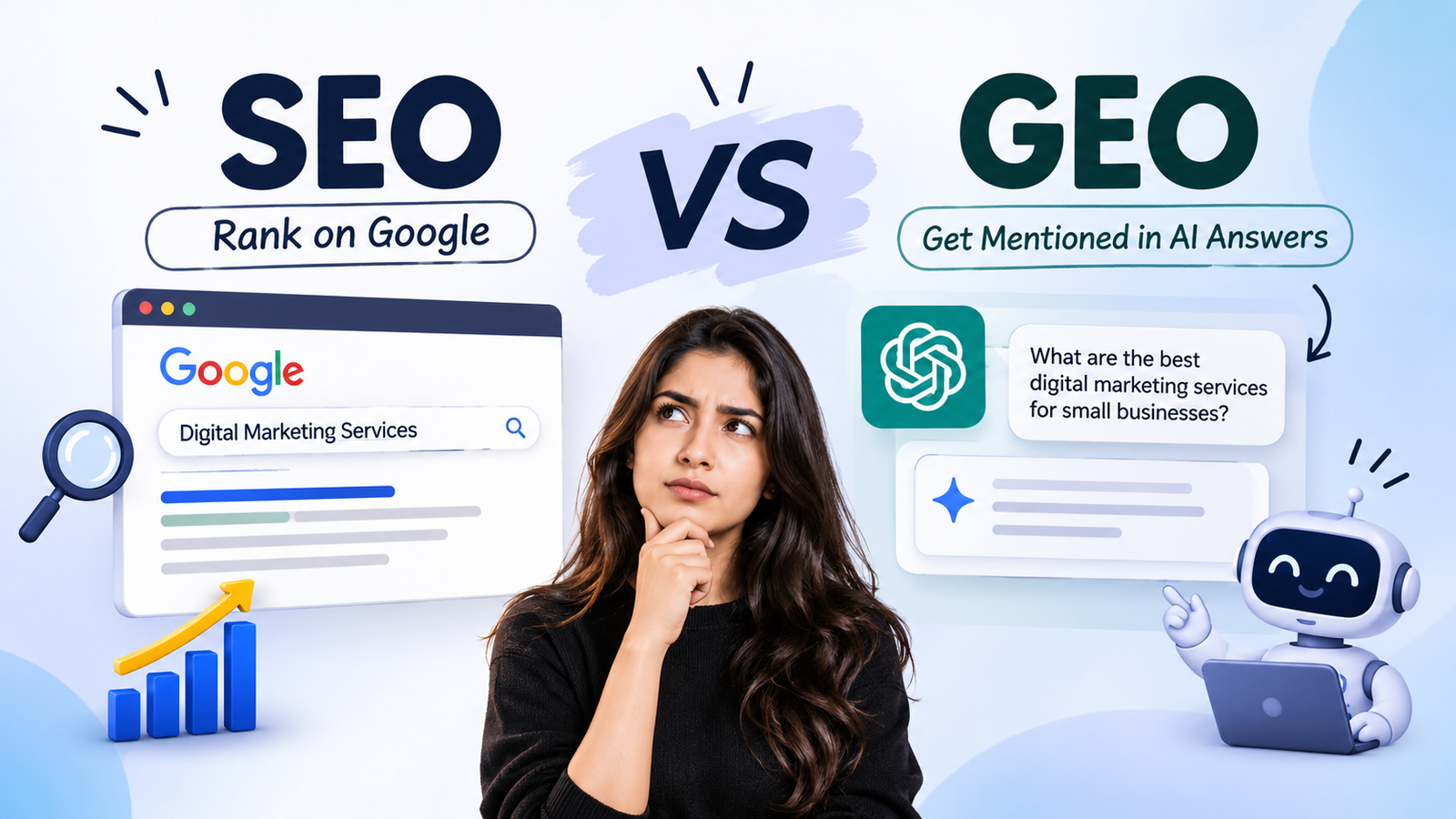
For instance, when searching for a digital marketing agency, you may search for it on Google and land on a couple of sites. Or perhaps you decide to search on ChatGPT.
Both are searching for the same thing; however, they use different methods.
This is important for businesses to consider. Whilst you are likely wanting to increase your traffic from Google, using AI powered platforms is becoming more prominent in how we discover information.
This is where GEO comes into play.
Most businesses will be familiar with SEO. GEO is a pretty new concept that people are becoming interested in.
How different is it? Let’s break it down.
SEO – What Most Businesses Know
Most people will have heard of ‘we need to improve our SEO’.
What does this actually mean?
Let’s say you are a small business selling handmade furniture. A customer has searched for “custom wooden furniture in Delhi.” on Google.
You would want your website to show up in this search. This is one of the main reasons businesses invest in SEO.
It will help improve your visibility of your website for certain searches.
Typically SEO will include;
Finding the right keywords
Creating helpful content for your site and blogs
Improving your page titles and meta descriptions
Making sure Google can crawl and index your pages
Getting backlinks from relevant websites
Improving your site speed and mobile optimisation
Whilst there isn’t anything too new here, it is still important.
Your site will need to be in good technical shape, relevant and high quality.
GEO – Why Everyone Is Talking About It!
Let’s say someone wants to purchase a laptop but aren’t sure which one. Instead of searching various sites, they may search ChatGPT.
‘Which laptop is good for students to use?’
ChatGPT will give them an answer based on the information. Based on the platform and search, it may also provide links.
This is what GEO is all about.
GEO stands for Generative Engine Optimisation. This focuses on increasing your chances of appearing in AI-generated answers.
For businesses, this means creating helpful information that AI tools can understand and mention.
How can you do this?
By answering common questions your customers ask.
If you offer website development services you could create content around;
How much does it cost to build a business website?
Should small businesses have a professional website?
What should every business website have?
How to choose the right website development company?
You’re not just making random content for your blog. This is what potential customers may ask themselves.
GEO Vs SEO – Where Are The Differences?
You might be wondering how these two are different. Whilst it may seem similar they are quite different.
Both involve creating helpful content, however where you want your business to be found differs.
Here is a comparison table;
| SEO | GEO |
| Acronym for Search Engine Optimization | Acronym for Generative Engine Optimization |
| Traditional search visibility | AI generated answers |
| Search Engines (Google/Bing) | Platforms such as ChatGPT/AI search |
| Keyword research and content optimisation | Providing helpful, clear and trustworthy information |
| Increase organic traffic | Increase chances of being found on AI |
| Rankings, clicks and impressions | Mentions, citations and referral traffic |
In Summary,
With SEO, you want your website to be shown in searches on Google.
With GEO, you want your brand/information to have a chance of being mentioned when someone asks an AI tool a related question.
Whilst neither will guarantee you visibility, it is good to know.
Should I Even Care About GEO?
This is probably where it gets interesting.
Not all businesses will need to completely change how they market, however it would be wise to consider the changes.
Someone may search for an accounting service provider.
They may search on Google for ‘accounting services small businesses’ or they may ask an AI tool ‘what accounting services do new businesses need?’
If you can provide helpful information around these topics you have more opportunities to reach potential customers.
There are a few reasons why GEO is gaining popularity;
More detailed questions.
Searches are becoming very conversational. People aren’t just typing 2-3 words but are explaining what they want.
Another way of discovering.
People are no longer relying on Google to find information. AI powered platforms are becoming a new way of discovering.
Helpful information.
Articles that are just copied from other websites won’t keep people interested. Providing practical examples and unique insights can really help.
Can I Use SEO And GEO Together?
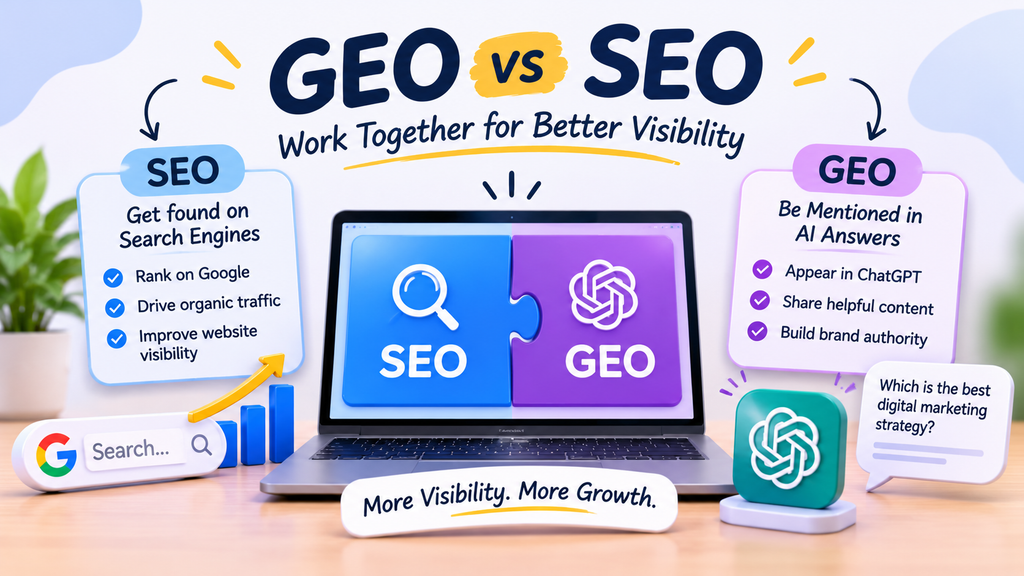
Yes! This is probably the most important thing to know.
You don’t have to stop doing SEO to do GEO.
Many of the activities can be combined.
Say a company wanted to improve their online presence. They already have a website and regularly blog.
Instead of completely changing their strategy they can improve the content they already produce.
Activity Benefit
Keyword research Know what potential customers are searching for
Informative blogs Provide helpful information
Clear headings Easy to navigate through
Technical SEO Help search systems find your pages
Backlinks from relevant websites Improve credibility of your website
Answering questions your customers have Make content more helpful and relevant.
Whilst these will not guarantee you rankings, they are sensible ways to improve your website and content.
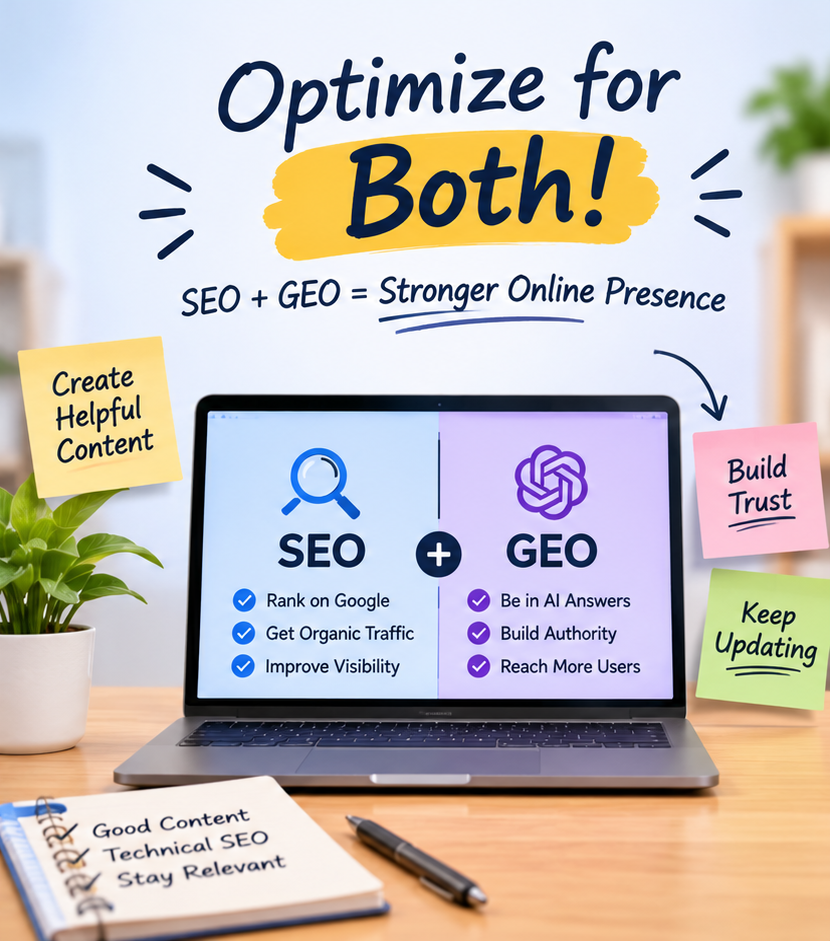
Simple Ways To Improve Your Website For Both GEO And SEO
Don’t overcomplicate it. Sometimes the best improvements can be made by looking at your current website.
1. Use The Right Keywords
It is common to use high volume keywords.
However, if they don’t relate to your business what’s the point?
A digital marketing company may target keywords such as;
How to improve Google rankings of your business website.
Best digital marketing strategies for small businesses.
How to increase organic traffic to your website.
How to improve brand visibility in AI search.
These are all long tail keywords and will help you understand what people are searching for.
2. Don’t Make Customers Search For The Answer.
If someone is reading your article to learn about GEO and SEO.
They probably don’t want to read a long introduction about the history of digital marketing.
Just answer their question.
Write in a simple way and get into detail. Short paragraphs, meaningful headings and examples can really help technical topics.
3. Give More Than Basic Information
There are plenty of articles explaining what SEO is.
What makes your article stand out?
Maybe provide examples, experiences from your industry or common issues that aren’t explained well in other articles.
Try to add something unique.
This is a great way to ensure your content is unique on your website.
4. Technical SEO
Sometimes people can get carried away with creating blogs and forget to make sure they can be indexed by Google.
This can cause issues.
Make sure you regularly check for any indexing issues on Google Search Console. Check for crawl errors and any issues on your website.
Your website should;
Be mobile friendly.
Load quickly.
Have working internal links.
Proper XML sitemap.
Clear page titles/descriptions.
5. Promote Your Brand
Whilst your website is important, you don’t want to only promote your brand here.
Give people helpful information on professional platforms. Get involved in relevant conversations within your industry and try to gain backlinks from relevant websites.
Don’t go for every backlink opportunity. A mention from a relevant website will generally mean more.
6. Improve Old Blogs
Don’t just create 10 new articles. Look at the ones you already have.
Is the information still accurate? Does the content answer the reader’s question? Also, are there any broken links or outdated examples?
Sometimes your blog just needs some improvements.
Updating useful content is a great way to improve the quality of your website.
GEO Vs SEO – What Should I Focus On?
There is no one answer for all businesses.
If your website is new and has little/no organic visibility, focus on improving the SEO of your website.
If your currently improving your SEO but want to understand how customers are discovering businesses using AI tools start with GEO.
Here is a quick comparison based on your goals;
Goal Focus
Improve Google rankings SEO
Increase Organic Traffic SEO
Improve Keyword Visibility SEO
Increase Brand Visibility (AI) GEO
Brand Mentioned (AI) GEO
Overall Online Visibility Both
Remember GEO shouldn’t replace your SEO.
You can improve your visibility on Google whilst also making your content more helpful for AI.
Common Mistakes
Don’t get too obsessed with numbers.
Don’t;
Repeat the same keyword throughout your paragraphs.
Create blogs with no new information.
Get backlinks from unrelated websites.
Ignore any indexing issues.
Expect to get cited immediately.
Go for every new trick.
There is no quick fix to making sure your brand is mentioned in AI answers.
Focus on improving your website.
Final Thoughts
The way people search online is constantly changing and businesses are starting to notice.
Whilst SEO is still important to help people find your website through traditional search engines, GEO is another area to consider as AI tools are becoming popular for research.
Don’t overcomplicate things.
Ensure your website is working. Understand what your customers are searching for. Provide helpful information. Don’t just create blogs to fill your content calendar.
Most importantly don’t forget about your audience.
Whether they find your business through Google or an AI tool they will want helpful information.
Frequently Asked Questions
1.What’s The Difference Between GEO And SEO?
SEO aims to increase your visibility in traditional searches. GEO aims to increase your chances of being mentioned in AI answers.
2.Is GEO Replacing SEO?
No. SEO is still an important factor in increasing your visibility in traditional searches. GEO is an additional area to consider due to the rise in AI searches.
3.Can I Do GEO Without SEO?
You can focus on GEO related content practices but without a full SEO campaign. Having a technically accessible website and good content will help.
4.How Can A Small Business Improve GEO?
Identify common questions your customers ask. Provide helpful answers. Provide unique information. Ensure your business details are accurate. Ensure your website is accessible.
5.Will My Website Be Mentioned In ChatGPT If I Rank Well On Google?
No. Just because you rank well on Google doesn’t mean your website will be mentioned on ChatGPT. Different platforms will have different ways of finding and showing information.
6.Will Long Tail Keywords Help With GEO?
Long tail keywords will help identify specific questions and topics your audience are interested in. Using them naturally will help provide more relevant content. However they won’t guarantee you will be cited.
7.How Can I Track GEO?
You can periodically check to see if your brand is being mentioned/cited in relevant AI answers. You can also track referral traffic from AI platforms.
One thought on “GEO vs SEO: Key Differences, Benefits & Strategies”