
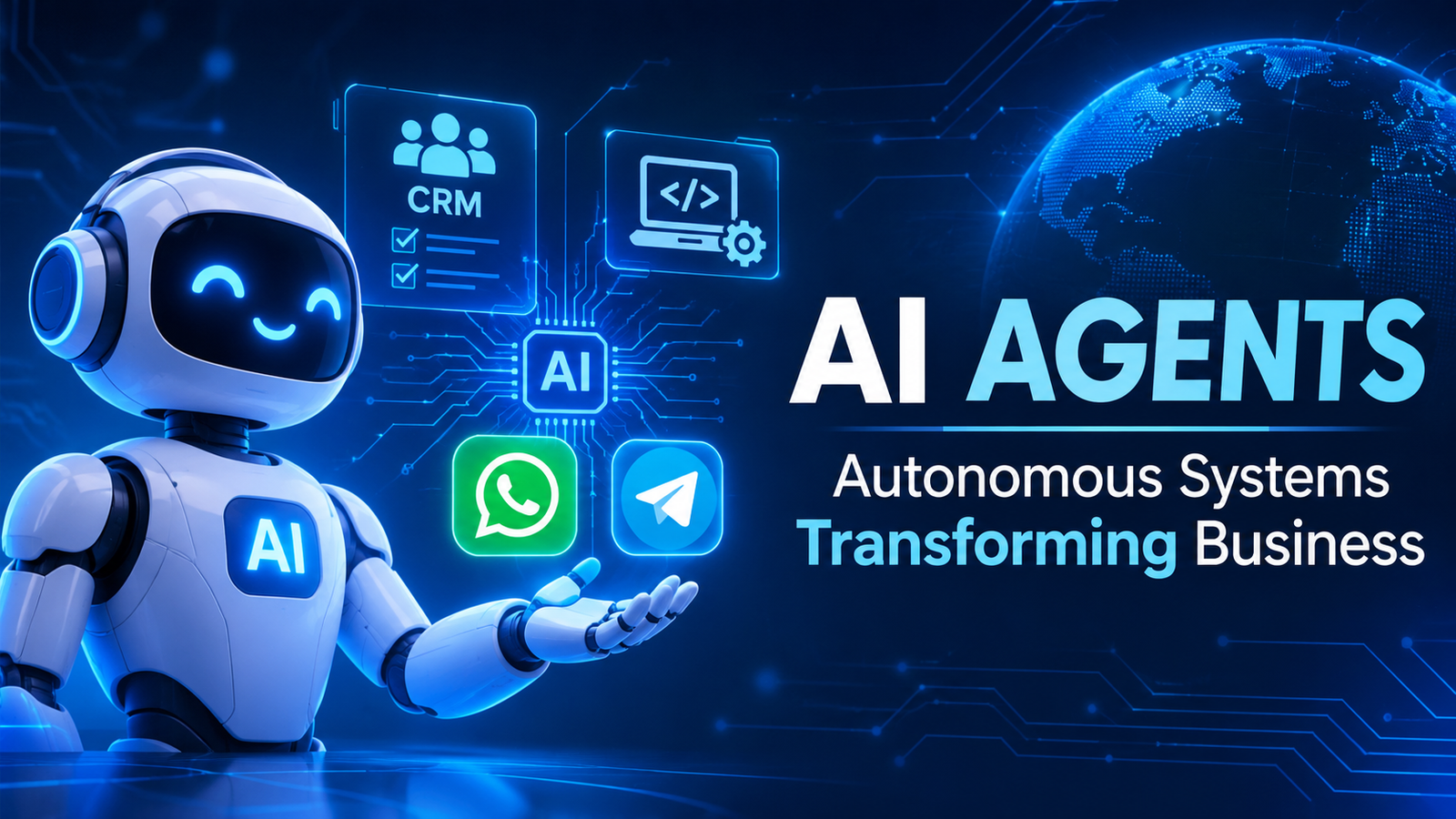
Artificial intelligence is being used more within businesses to help answer questions, write and manage customer data, code and communications.
AI Agents
An AI Agent can understand what a user wants, plan and use different tools to carry out tasks. They can be used to integrate with CRMs, send messages on WhatsApp/Telegram and help with development.
How do they work?
What is an AI Agent?
An AI Agent is a piece of software that can understand, decide, and perform specific tasks.
Unlike a regular chatbot, an AI Agent can help to carry out tasks.
Whilst a chatbot could be asked to search for information about a customer, it may just give you the answer.
With an AI Agent integrated with your CRM it can:
- Search for existing customer profiles
- Search for previous interactions
- Update contact info
- Create follow-up tasks
- Notify sales team.
The main difference is the AI Agent can use the integration to complete tasks.
AI Chatbot vs AI Agent
| AI Chatbots | AI Agents |
| Mainly answer questions | Can complete tasks |
| Usually follow a conversation | Can plan multiple steps |
| Have limited tool access | Can connect with external tools |
| Mostly respond to instructions | Can work towards defined goals |
| Usually require more human direction | Can automate workflows within set permissions |
How Autonomous AI Agents work
One of the exciting features of AI is the use of autonomous systems.
An autonomous AI Agent can work towards the goal without any human interaction.
For example if a business wants the AI to manage new customer inquiries:
1.Receive
2.Understand
3.Search
4.Decide
5.Send
6.Login to CRM.
All of this can be carried out automatically with the right integrations in place.
What Makes an AI Agent Autonomous?
There are a variety of tools to help make an AI Agent Autonomous:
Large Language Models (LLMs) – Understand instructions and create responses.
Memory – Save relevant information.
APIs – Can interact with external applications.
Tools – Can complete tasks such as sending messages, updates and searches.
Plan – Break down large goals into smaller tasks.
Feedback – Can understand what has been completed and what to do next.
They can complete complex workflows.
How are AI Agents transforming CRM?
Customer Relationship Management (CRM) can help businesses manage their customer data, sales and communications.
Keeping your CRM up to date and following up with potential customers can be time consuming. By integrating AI agents into your CRM platforms many tasks can be automated.
AI-powered lead management can also help businesses identify potential customers, organise enquiries and improve their follow-up process through AI lead generation.
What Can AI Agents do with CRM?
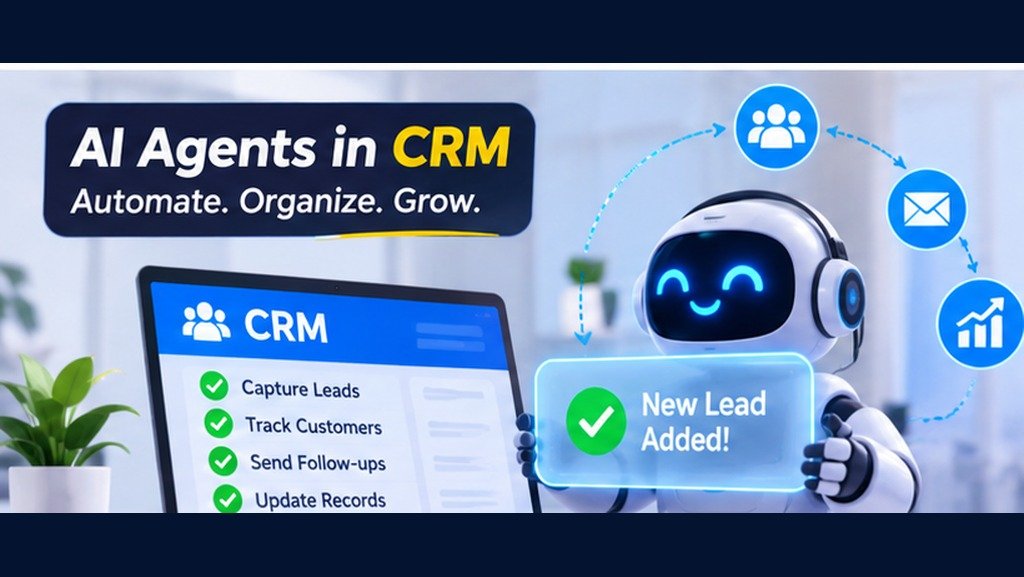
1.Lead management:
AI Agents can extract information from forms, messages etc. They can manage new leads and add them to your CRM.
2.Following up with customers:
AI Agents can automatically identify customers to follow-up with. They can create/prep messages based on your pre-defined rules.
3.Updating customer info:
If any new info is provided by a customer the AI agent can update relevant fields in your CRM (if permitted).
4.Understanding customer needs:
AI Agents can analyse conversations with customers to understand what they want.
5.Supporting sales teams:
They can help sales teams with managing leads, tracking and identifying opportunities.
Traditional CRM vs AI Powered CRM
| Traditional CRM | AI-Powered CRM |
| Requires manual data entry | Can automate data updates |
| Follow-ups are often scheduled manually | Can trigger follow-ups automatically |
| Limited conversation analysis | Can analyse customer messages |
| Relies heavily on manual reporting | Can generate useful summaries |
| Employees manage most routine tasks | AI Agents can handle selected workflows |
For example, if a customer submits an enquiry from your website the AI agent can extract the information, create a new entry in your CRM, sort the lead and send a first response.
This can help reduce repetition and allows employees to focus on important customer interactions.
Can AI Agents Write and Modify Their Own Code?
One of the exciting features of AI is coding agents. They can write, test and modify code.
Some coding agents are very advanced and can look at an existing project to identify issues and update the code base.
Sometimes referred to as self-modifying AI or autonomous development.
However, this does not mean the AI will modify the internal structure or training of the model but the code of the application itself.
How Does AI Code Modification Work?
A developer may ask an AI coding agent to fix an issue on their website.
The AI agent may:
1.Understand what the developer needs.
2.Review the relevant files and identify what the issue is.
3.Suggest what needs to be changed.
4.Modify the files.
5.Test the changes.
6.Improve – If the tests fail the AI can research and try to find an alternative solution.
This can help reduce the repetition of coding.
How Is This Different From Traditional Coding?
| Traditional Software Development | AI-Assisted Development |
| Developers manually inspect code | AI can analyse relevant files |
| Developers write every change | AI can generate code modifications |
| Testing is managed manually or through automation | AI can help run and analyse tests |
| Developers investigate errors | AI can help identify potential causes |
| Changes depend on developer input | Agents can handle selected coding tasks independently |
AI coding agents still need some oversight. When making large changes to live apps you should always check the code has been updated, tested and have copies.
How Can AI Agents automatically reply on WhatsApp/Telegram?
AI agents are becoming a great tool when it comes to helping with business communications.
Many companies may receive questions from customers. This can become an issue when trying to reply to every message. Especially if you receive a lot of messages throughout the day.
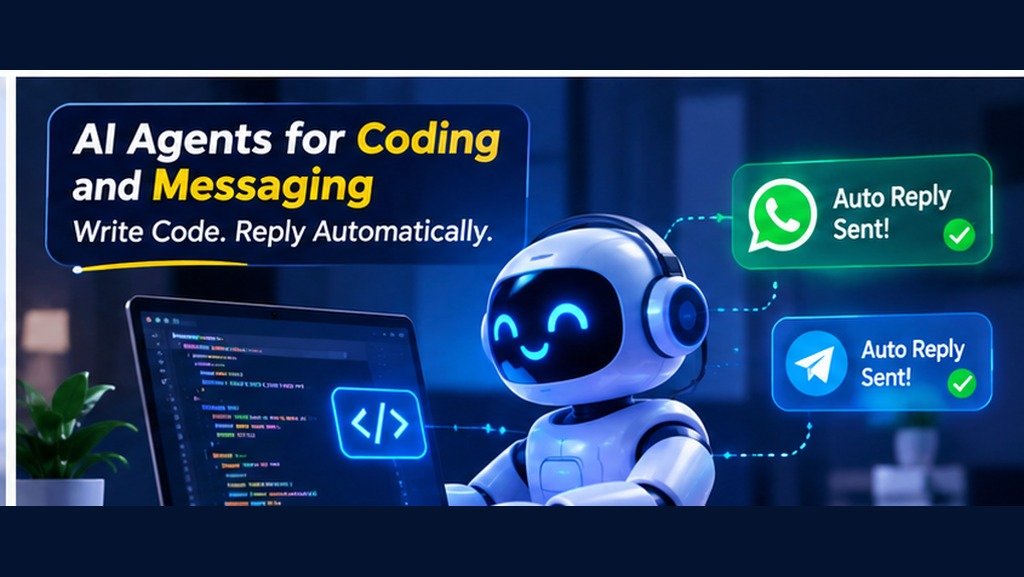
AI agents can help. Using APIs and supported bots you can integrate with messaging platforms.
Tools like OpenClaw AI show how artificial intelligence can connect with messaging platforms and external tools to automate everyday tasks.
WhatsApp Automation with AI Agents
Business can use AI powered systems with WhatsApp Business.
For example if a customer messages about a service:
- Receive – Message received.
- Understand – Understand what the customer needs.
- Find – Find relevant information about your business.
- Create – Create a suitable response.
- Send – Send using supported WhatsApp integration.
- Log – Log conversation into CRM.
This integration can be used to confirm appointments, update orders and provide customer support.
However, messages sent on WhatsApp still need to follow Meta’s rules.
Telegram Automation with AI Agents
Telegram also has bots available. AI agents can communicate with users.
AI agents can:
- Answer common questions.
- Provide information about products/services.
- Automatically send notifications.
- Collect customer information.
- Integrate with external databases.
- Start tasks in other business applications.
For example a company can create a bot on Telegram to answer customer questions and pass complex ones on to their support team.
WhatsApp vs Telegram Automation
| Feature | Telegram | |
| Customer communication | Yes | Yes |
| Automated responses | Through supported business integrations | Through Telegram bots |
| CRM integration | Possible through APIs and connected tools | Possible through APIs and connected tools |
| Notifications | Supported with platform rules | Supported through bots |
| Business support automation | Yes | Yes |
AI agents will not automatically have access to these platforms. You should ensure you have the correct APIs, bots, permissions and integrations in place.
How can AI Agents integrate with different applications?
The real power of an AI agent is its ability to integrate with multiple applications.
Rather than just one integration, your AI agent can coordinate between services.
For example if you have a CRM, WhatsApp, Telegram and Email:
The AI agent could:
1.Receive – New enquiry received via WhatsApp.
2.Check – Check customer details in CRM.
3.Find – Find relevant product information.
4.Create – Create personal response.
5.Update – Update customer.
6.Create Reminders – Create reminder for sales team to follow-up.
This can be done using APIs and automation.
This helps create an integrated workflow.
Benefits of Using Autonomous AI Agents
If set up correctly, AI agents can provide many benefits:
- Reduces repetition – Automate repetitive tasks such as data entry and customer responses.
- Fast communications – Provide quick responses to common questions.
- Improved CRM – Organise customer data better.
- Helps with development – Helps developers with writing, reviewing and modifying code.
- Integration with applications – Can integrate with various business applications.
- Scalable – Can help with more high volume repetitive tasks as your business grows.
However, not everything should be automated. Any issues relating to customers, money and major changes to software will require human approval.
Challenges of using AI Agents
Whilst there are many opportunities with autonomous systems there are some challenges.
| Challenge | Why It Matters |
| Data privacy | Customer information must be handled securely |
| Incorrect responses | AI can misunderstand instructions or provide inaccurate information |
| Security risks | Poorly configured permissions can create vulnerabilities |
| Integration complexity | Different platforms require different APIs and configurations |
| Human supervision | Important actions may require approval |
| Operating costs | API usage and infrastructure can increase expenses |
Ensure you have clear permissions, monitor the AI agents and test workflows.
Future of AI Agents
AI agents are evolving with improved AI models, integrations and autonomous systems. Businesses may be able to automate complex tasks.
We can expect to see improvements in:
AI Customer Relationship Management.
Autonomous development.
Smart customer support.
Automated sales & marketing.
Multiple agents.
AI communication.
The aim is to create intelligent software with integrated, efficient and easy to manage business processes.
Conclusion
AI agents are changing how businesses interact with technology. They can help with managing CRM, helping with development, modifying code and communicating with customers on WhatsApp and Telegram.
The main benefit is they can integrate with various tools and complete multi-step tasks to achieve a specific goal.
However, it is important to have the correct integrations, security and human oversight.
As autonomous systems improve AI agents may become an important part of everyday business processes.
Frequently Asked Questions
What is the difference between an AI Agent and AI chatbot?
An AI chatbot will primarily answer questions whilst an AI agent can use integrations, make decisions and complete tasks to complete specific tasks.
Can AI Agents modify code?
Some AI coding agents can look at existing source code, identify issues, write new code and modify files. However they should be tested and reviewed by developers.
Can AI Agents automatically reply to messages on WhatsApp?
Yes! AI agents can reply to messages on WhatsApp using the supported WhatsApp Business Integrations, APIs and automation.
Can AI Agents integrate with CRM?
Yes! AI agents can integrate with CRM platforms to help organise customer data, update, manage leads and automatically follow-up.
Can AI Agents automatically send messages on Telegram?
Yes! AI agents can use bots on Telegram to reply to messages, provide information and complete some automated tasks.
Are autonomous AI Agents fully independent?
No. Whilst they can complete many tasks depending on their permissions it is important to have human oversight to ensure security, accuracy and sensitive decisions are made.

One thought on “AI Agents: How Autonomous Systems Are Transforming CRM, Coding and Business Communication”