
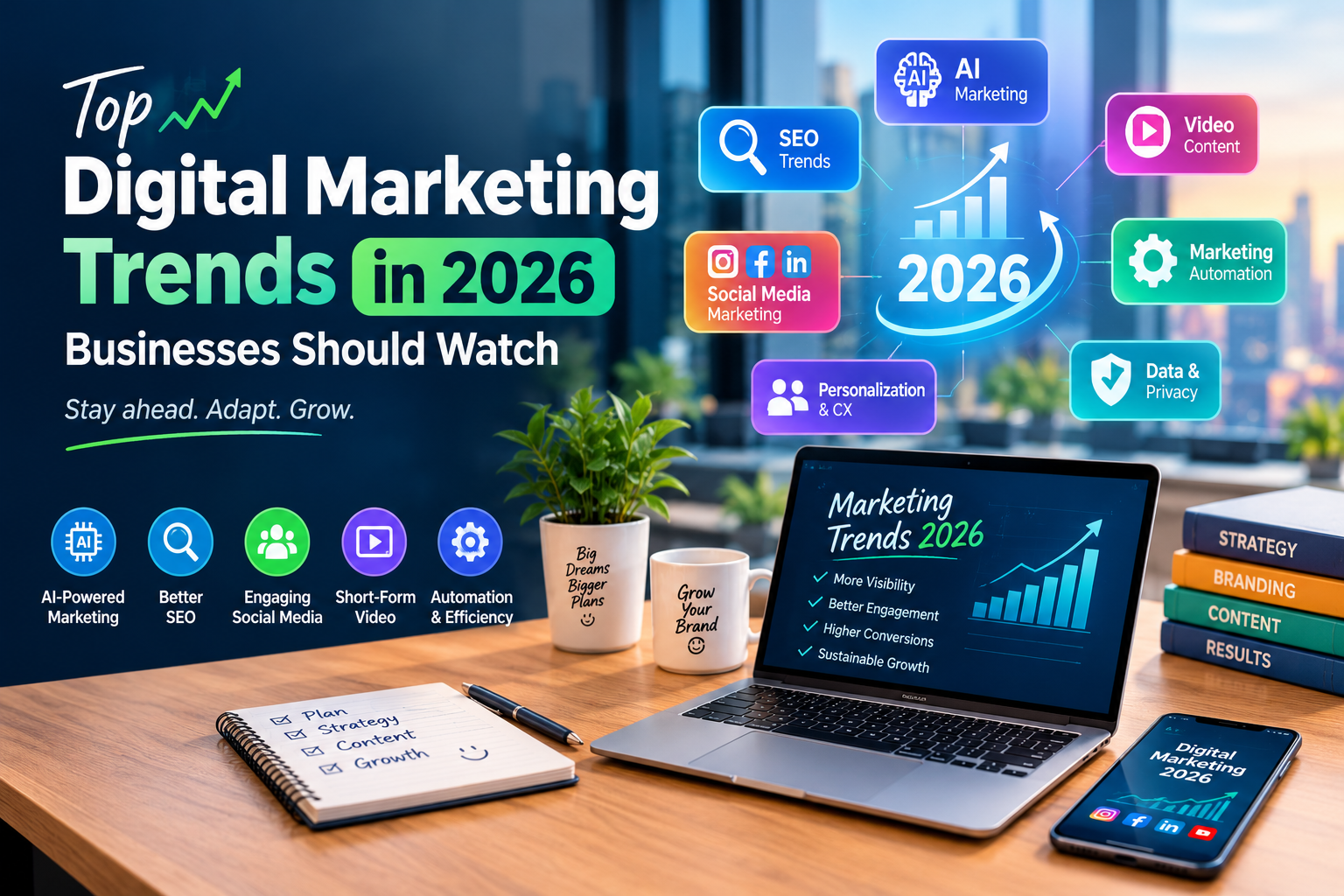
Digital marketing continues to evolve as customer expectations, technology, and online platforms change. Businesses can no longer rely only on traditional advertising methods or outdated marketing strategies to reach their audiences effectively. They need to understand how people discover brands, consume content, compare products, and make purchasing decisions online.
The digital marketing trends 2026 landscape is shaped by artificial intelligence, personalized customer experiences, search innovation, short-form video, marketing automation, and data-driven decision-making. These developments create opportunities for businesses to improve their online visibility, communicate more effectively, and build stronger customer relationships.
However, following every new trend is not necessary. The most effective approach is to identify the strategies that match your business goals, target audience, and available resources.
In this guide, we will explore the major marketing developments businesses should watch in 2026 and explain how to apply them to a practical digital marketing strategy.
Why Should Businesses Follow Digital Marketing Trends in 2026?
Customer behaviour and digital platforms are constantly changing. A strategy that worked well in the past may need adjustments to remain relevant today.
Understanding current marketing developments helps businesses identify new opportunities, improve customer experiences, and allocate their marketing budgets more effectively.
Here are some important reasons to monitor digital marketing trends:
- Improve online visibility: Adapt your content and SEO strategy to changing search behaviour.
- Reach relevant audiences: Use customer insights to create more useful and targeted campaigns.
- Improve efficiency: Apply suitable automation tools to reduce repetitive tasks.
- Strengthen customer relationships: Deliver relevant communication across appropriate channels.
- Measure marketing performance: Use analytics to understand which activities support business goals.
- Stay competitive: Identify useful opportunities before committing resources to new platforms or technologies.
The goal is not to adopt every new tool. It is to understand which developments can provide meaningful value to your customers and business.
10 Digital Marketing Trends 2026 Businesses Should Watch
The following trends highlight important areas businesses can explore when planning their marketing activities for 2026.
1. AI-Powered Marketing and Automation
Artificial intelligence is becoming an increasingly useful part of digital marketing workflows. Businesses can use AI tools to support content planning, customer research, campaign analysis, customer service, and repetitive marketing tasks.
AI-powered marketing tools can help teams organize information, generate initial content drafts, identify patterns in campaign data, and assist with customer interactions.
For example, an online store may use an AI assistant to answer common product questions, while a service business may automate enquiry routing and appointment reminders.
How Businesses Can Use AI Marketing
- Generate content ideas based on customer questions.
- Analyze campaign performance and identify areas for improvement.
- Assist with customer support and frequently asked questions.
- Automate repetitive administrative marketing tasks.
- Organize and qualify enquiries using appropriate customer data.
AI should support human judgment rather than replace it entirely. Marketing teams should review generated content for accuracy, originality, brand consistency, and usefulness before publishing.
Businesses should also consider privacy, data security, and the limitations of automated systems when implementing AI solutions.
2. Generative Engine Optimization (GEO) and AI Search Visibility
Search behaviour is evolving as users explore AI-generated answers, conversational search experiences, and traditional search engine results.
Generative engine optimization (GEO) generally refers to efforts to improve the likelihood that a brand’s useful information is understood, surfaced, or referenced in AI-powered search experiences.
Although GEO practices and outcomes are still evolving, businesses can take practical steps to make their content clearer and more useful.
How to Prepare Your Website for AI Search
- Publish accurate and helpful content that answers specific questions.
- Organize articles with clear headings and logical sections.
- Include relevant facts, examples, and explanations.
- Keep business information consistent across trusted online sources.
- Strengthen website accessibility and technical SEO.
- Demonstrate relevant expertise and provide trustworthy information.
Traditional SEO remains important. Businesses should continue creating useful pages for people instead of relying on unsupported promises about AI search rankings or guaranteed citations.
The broader objective is to make your brand’s information accessible, relevant, and easy to understand across different discovery channels.
3. High-Quality, Search-Focused Content Marketing
Content marketing remains an important way to educate audiences, answer customer questions, and demonstrate expertise.
However, publishing large volumes of generic articles is not a reliable substitute for useful content. Businesses should focus on original insights, clear explanations, relevant examples, and information that addresses the needs of their target audience.
For instance, a digital marketing agency can publish practical guides about SEO, paid advertising, website optimization, and lead generation.
Content Marketing Strategies for 2026
- Research topics that match your audience’s questions.
- Create detailed articles that solve specific problems.
- Update older content when information becomes outdated.
- Add original examples and genuine case studies.
- Use relevant internal links to connect related pages.
- Repurpose useful articles into videos, newsletters, and social media posts.
AI can help with research organization and drafting, but human review is essential. Content should be accurate, original, and valuable rather than created simply to increase publishing frequency.
A focused content strategy can support organic visibility, brand awareness, and customer education over time.
4. Short-Form Video Marketing
Short-form videos continue to provide businesses with a format for introducing products, explaining services, demonstrating processes, and sharing useful information.
Platforms such as Instagram Reels, YouTube Shorts, and TikTok offer different ways to distribute video content, depending on the audience and market.
A business does not need an expensive production setup to begin. Clear audio, a relevant message, and useful information can be more important than complicated visual effects.
Short-Form Video Ideas for Businesses
- Answer common customer questions.
- Demonstrate how a product works.
- Share practical tips related to your industry.
- Explain a service in simple terms.
- Show genuine behind-the-scenes activities.
- Present customer experiences with appropriate permission.
- Explain a case study using accurate, verifiable results.
Start with a clear opening, communicate one main idea, and finish with a relevant next step.
Measure performance using meaningful indicators such as watch time, engagement, website visits, and qualified enquiries rather than views alone.
5. Personalization and Customer Experience
Customers expect relevant information and convenient experiences. Generic messages that ignore their needs may be less useful than communication tailored to their interests and stage in the buying journey.
Personalization can include relevant product recommendations, segmented email campaigns, useful follow-up messages, and landing pages designed for specific audiences.
For example, a software company might send different educational resources to users who are exploring a product and customers who have already purchased it.
How to Improve Marketing Personalization
- Group audiences according to relevant needs or interests.
- Create content for different stages of the customer journey.
- Recommend products or services when they are genuinely relevant.
- Use customer feedback to improve communication.
- Respect consent and communication preferences.
- Avoid collecting or using unnecessary personal information.
Effective personalization should make the customer experience more useful, not intrusive.
Businesses should balance personalization with transparency, privacy, and responsible data practices.
6. First-Party Data and Privacy-Focused Marketing
First-party data is information a business collects directly through its own customer relationships and digital channels, subject to applicable privacy requirements.
Examples include voluntary newsletter subscriptions, customer feedback, purchase history, and interactions with a company’s website.
As privacy expectations and advertising measurement methods evolve, businesses benefit from developing responsible ways to understand their audiences.
How Businesses Can Build a First-Party Data Strategy
- Offer useful resources in exchange for voluntary subscriptions.
- Collect only information that serves a clear business purpose.
- Explain how customer information will be used.
- Maintain accurate and secure customer records.
- Respect consent, unsubscribe requests, and applicable privacy laws.
- Use analytics and conversion tracking appropriately.
For example, a business can offer a practical industry guide to people who voluntarily subscribe to its newsletter.
This creates an opportunity to maintain relevant communication without depending entirely on rented audiences or third-party platforms.
Responsible data practices can support better customer relationships and more reliable marketing operations.
7. Social Media Community Building and Creator Partnerships
Social media is not just a place to publish promotional messages. It can also help businesses develop communities, answer questions, understand customer interests, and build relationships.
Creator partnerships can introduce products and services to relevant audiences through demonstrations, reviews, educational content, or collaborative campaigns.
The best partnership depends on audience relevance, credibility, content quality, and campaign objectives rather than follower count alone.
Ways to Strengthen Social Media Marketing
- Respond to relevant questions and comments.
- Publish educational and practical content.
- Encourage genuine customer participation.
- Work with creators whose audiences match your target market.
- Disclose paid partnerships where required.
- Track referral traffic, enquiries, and conversions when possible.
Businesses should choose platforms based on where their audiences are active and the type of content they can produce consistently.
A smaller, relevant community may be more valuable to a business than a large audience with little interest in its offerings.
8. Omnichannel Marketing and Consistent Brand Communication
Customers may discover a business through search engines, social media, email, advertisements, or recommendations before contacting the company.
Omnichannel marketing aims to create a more connected and consistent customer experience across these different touchpoints.
For example, a potential customer may discover a business through a blog article, view its social media profile, and later contact the company through its website.
Consistent messaging and accurate information help the customer understand the business throughout this journey.
How to Develop an Omnichannel Strategy
- Maintain consistent brand messaging across platforms.
- Keep business contact information accurate.
- Connect relevant campaigns with appropriate landing pages.
- Coordinate email, social media, and website communication.
- Make it easy for customers to move between discovery and enquiry.
- Track customer interactions where technically and legally appropriate.
Businesses do not need to operate on every platform. They should prioritize the channels that work together to support their customers and business objectives.
9. Conversion Rate Optimization and Better Landing Pages
Attracting website visitors is only one part of digital marketing. Businesses also need to make it easy for relevant visitors to take the next step.
Conversion rate optimization (CRO) involves improving a website or landing page to increase the proportion of visitors who complete a desired action.
That action might be submitting an enquiry, booking an appointment, requesting a quote, or purchasing a product.
Practical Conversion Optimization Techniques
- Use clear and descriptive headlines.
- Explain the main benefits of your offering.
- Make contact forms simple and relevant.
- Add visible calls to action.
- Improve mobile usability and page loading.
- Address common customer concerns.
- Test changes and evaluate the results.
For example, a service business may improve its landing page by clearly describing the service, explaining the process, answering frequently asked questions, and adding an easy-to-use enquiry form.
Businesses should make changes based on evidence rather than assuming every design trend will improve conversions.
10. Data-Driven Marketing and Better Measurement
Marketing analytics helps businesses understand how their campaigns perform and whether they support business objectives.
Rather than relying exclusively on impressions, followers, or website visits, businesses should measure outcomes that matter to their particular goals.
For example, a lead-generation campaign may prioritize qualified enquiries and cost per lead, while an online store may focus on purchases, revenue, and customer acquisition costs.
Important Marketing Metrics to Monitor
- Organic search impressions and clicks
- Relevant website traffic
- Engagement with useful content
- Qualified leads and enquiry rates
- Conversion rates
- Cost per acquisition
- Advertising return on investment
- Repeat purchases and customer retention
Tools such as Google Analytics 4, Google Search Console, and advertising platform reporting can help businesses understand different aspects of their performance.
Accurate measurement depends on correct configuration, clear definitions, and responsible data collection.
Regular reporting allows marketing teams to identify what is working, investigate underperforming campaigns, and improve resource allocation.
How to Choose the Right Digital Marketing Trends for Your Business
Not every trend is suitable for every company. A small local business may have different priorities from a large e-commerce brand or a B2B software company.
Use the following process to select suitable opportunities.
Step 1: Define Your Business Goals
Decide whether you want to improve brand awareness, increase organic traffic, generate qualified leads, improve sales, or strengthen customer retention.
Clear objectives help you identify which marketing activities are worth exploring.
Step 2: Understand Your Audience
Research your customers’ needs, questions, preferences, and purchasing behaviour.
Choose channels and content formats that suit their interests rather than adopting a platform simply because it is popular.
Step 3: Evaluate Your Current Marketing Performance
Review your website, SEO, social media profiles, content, and advertising campaigns.
Identify existing strengths and areas where improvements may have a meaningful impact.
Step 4: Prioritize a Small Number of Opportunities
Choose one or two relevant initiatives to test first.
For example, a business with limited search visibility may prioritize SEO and useful blog content before investing heavily in advanced marketing automation.
Step 5: Measure and Improve
Set realistic performance indicators, monitor the results, and refine your approach.
Continue investing in activities that demonstrate value, and reconsider those that do not support your goals.
This approach helps businesses adapt to new developments without spreading their budgets and teams too thinly.
Common Digital Marketing Mistakes to Avoid in 2026
Even promising marketing opportunities can produce disappointing results when implemented without a clear plan.
Avoid these common mistakes:
Following every new trend: Choose strategies based on business relevance, not popularity alone.
Using AI without reviewing the output: Verify facts, improve originality, and maintain your brand’s voice.
Ignoring SEO fundamentals: Continue investing in helpful content, technical website quality, and a clear site structure.
Focusing only on vanity metrics: Measure qualified enquiries, conversions, and other meaningful outcomes.
Neglecting customer privacy: Collect and use customer information responsibly.
Publishing inconsistent content: Maintain a realistic schedule and focus on usefulness.
Expecting instant results: Different channels have different timelines, and performance depends on competition, execution, and audience needs.
A balanced approach allows businesses to experiment with new methods while maintaining a reliable marketing foundation.
How Tech Earth Can Help Businesses Adapt to Digital Marketing Trends
Understanding marketing trends is useful, but businesses also need a practical plan to apply relevant strategies.
Tech Earth Global Business Solution can be explored as a potential partner for businesses looking to strengthen their digital presence through services such as SEO, website development, social media marketing, paid advertising, and content marketing.
Depending on your business requirements, you may want to consider:
- SEO: Improve website structure, relevant content, and organic search visibility.
- Website development: Create a user-friendly website that communicates your brand and services.
- Social media marketing: Build a consistent presence and engage with relevant audiences.
- Paid advertising: Reach suitable audiences through carefully planned campaigns.
- Content marketing: Publish useful articles and resources that answer customer questions.
- Analytics and optimization: Measure performance and identify opportunities for improvement.
The most suitable combination depends on your industry, audience, budget, and business goals.
Explore the Tech Earth website to learn more about its business and digital services.
When publishing this article, add a direct internal link to the most relevant service page and one or two related blog posts. Suitable supporting topics include SEO strategies, AI in digital marketing, social media marketing, and digital marketing strategy.
Conclusion
The digital marketing trends 2026 landscape offers businesses new ways to improve visibility, understand customers, streamline workflows, and create more useful digital experiences.
AI-powered marketing, AI search visibility, content marketing, short-form video, personalization, privacy-focused data practices, social media communities, omnichannel communication, conversion optimization, and analytics are all worth evaluating.
However, successful marketing is not about adopting every new tool or platform. It is about understanding your audience, selecting relevant strategies, delivering genuine value, and measuring the results.
Start with a clear business objective, test the opportunities that best fit your needs, and improve your strategy as customer expectations and digital platforms evolve.
With a thoughtful and consistent approach, businesses can use these developments to strengthen their digital presence and build a more sustainable marketing process.